Domestic automobile sales in India recorded strong double-digit growth across major vehicle segments in April 2026, with passenger vehicles and three-wheelers achieving their highest-ever monthly sales, according to data released by the Society of Indian Automobile Manufacturers (SIAM).
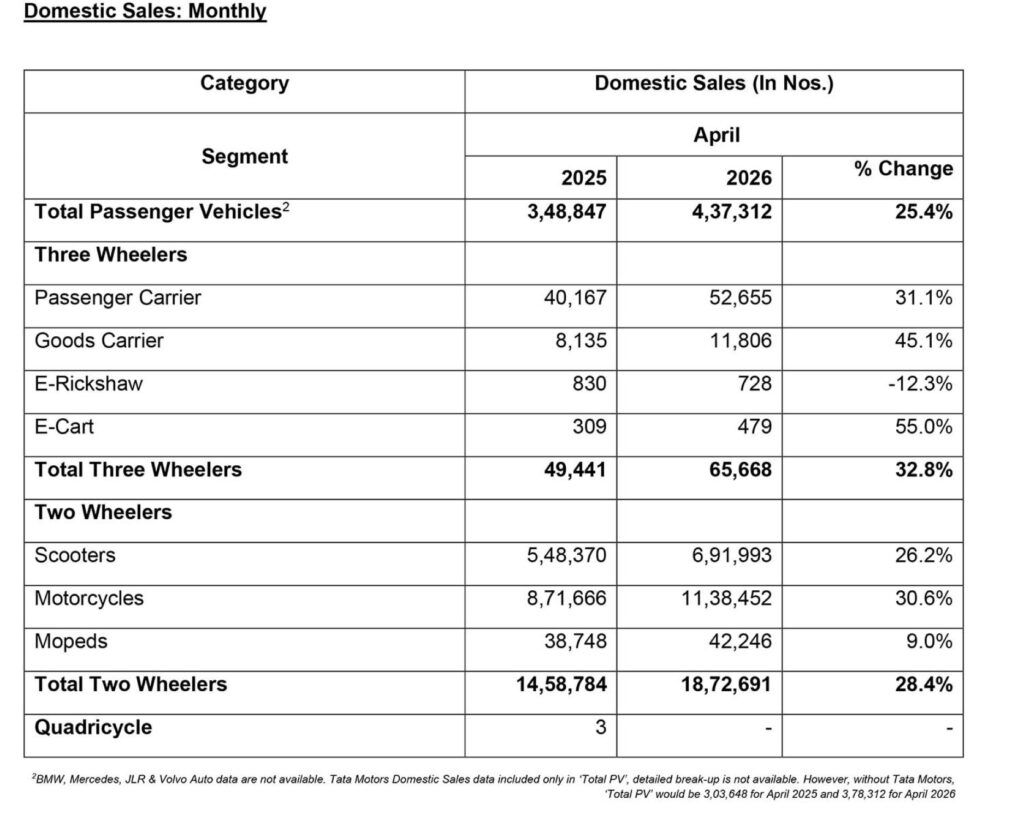
Passenger vehicle domestic sales reached 4,37,312 units in April 2026, registering a 25.4% year-on-year increase compared to 3,48,847 units sold during the same month last year.
Three-wheeler sales also posted significant growth, rising 32.8% to 65,668 units from 49,441 units in April 2025.
Meanwhile, domestic two-wheeler sales grew 28.4% year-on-year to 18,72,691 units, compared to 14,58,784 units in the corresponding month of the previous year.
Overall production of passenger vehicles, two-wheelers, three-wheelers, and quadricycles stood at 29,22,427 units during April 2026.
Strong growth across vehicle segments
Within the three-wheeler category:
- Passenger carrier sales increased 31.1% to 52,655 units
- Goods carrier sales rose 45.1% to 11,806 units
- E-cart sales jumped 55% to 479 units
- E-rickshaw sales declined 12.3% to 728 units
In the two-wheeler segment:
- Scooter sales grew 26.2% to 6,91,993 units
- Motorcycle sales increased 30.6% to 11,38,452 units
- Moped sales rose 9% to 42,246 units
SIAM noted that sales data from certain OEMs including BMW, Mercedes-Benz, Jaguar Land Rover, and Volvo Cars was unavailable. The organisation also stated that domestic passenger vehicle sales from Tata Motors were included only in the total passenger vehicle industry count.
Industry sees strong start to FY27
Rajesh Menon, Director General of SIAM, said the Indian automobile industry entered FY27 with sustained demand momentum across key vehicle categories.
He noted that the strong performance in April 2026 continued the momentum witnessed during the second half of FY2025-26, with passenger vehicles, three-wheelers, and two-wheelers all registering robust double-digit growth.
However, Menon also highlighted concerns regarding rising commodity prices linked to geopolitical disruptions in West Asia, while adding that overall market demand continues to remain positive.