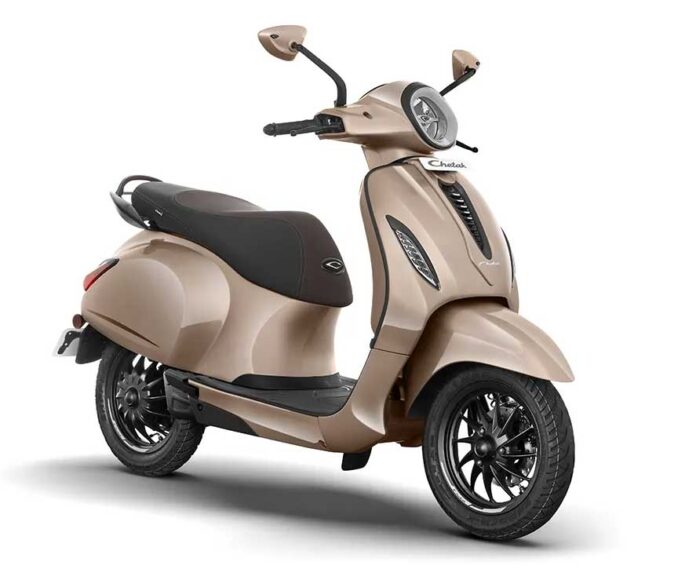
Bajaj Auto is preparing a significant expansion of production capacity for its Chetak electric scooter as demand for the model continues to exceed supply across the Indian market.
Speaking during the company’s Q4 earnings conference call, Rakesh Sharma said Bajaj Auto is undertaking “serious work” to substantially increase Chetak production capacity in response to accelerating demand in the electric scooter segment.
According to Sharma, the company has reached a stage where a meaningful expansion in manufacturing capacity is now necessary to support future growth.
Chetak Demand Continues to Surge
Bajaj Auto has been averaging monthly sales volumes of around 35,000 units in the electric scooter segment, where TVS Motor Company remains one of its key competitors.
Sharma acknowledged that the company has faced challenges in fully meeting market demand due to operational constraints across departments and the supply chain. However, he noted that production and supply conditions improved toward the end of the fourth quarter, enabling monthly production capacity to reach 50,000 units.
The company now aims to fully utilise this capacity while monitoring challenges related to labour availability and supply constraints among Tier 1 and Tier 2 vendors.
Record Retail Sales for Chetak
During Q4, Chetak crossed the one lakh retail sales milestone for the first time in a single quarter.
March emerged as the brand’s strongest month, with retail sales surpassing 50,000 units. Market share also climbed to nearly 23 per cent as consumer preference for electric scooters continued to strengthen.
According to Sharma, the e-scooter segment recorded 40 per cent growth during Q4 and continued expanding at more than 60 per cent growth in April, significantly outperforming the internal combustion engine (ICE) scooter segment.
A key contributor to this momentum has been the recently launched Chetak C25 variant, which was introduced to address the mobility requirements of younger riders seeking lighter, faster, and more convenient urban transportation solutions.
The company said the C25 has received a strong market response due to its combination of practicality, durability, and build quality.
Expanding Network and International Presence
In FY26, Chetak crossed the five lakh cumulative sales milestone and expanded its retail presence to over 500 exclusive stores along with access to more than 3,000 shared motorcycle outlets across 850 cities in India.
Sharma said this extensive network enables Bajaj Auto to maintain both strong reach and a differentiated customer experience for the Chetak brand.
The fourth quarter also marked the beginning of Chetak’s international expansion with exports commencing to Sri Lanka, Philippines, and Nepal.
Bajaj Auto Achieves Record Export Revenue
Alongside strong domestic EV performance, Bajaj Auto reported its highest-ever export revenue of $2.2 billion in FY26.
The company recorded its second-highest export volumes, supported by strong growth in Latin America and recovery in key international markets including Nigeria.
According to Sharma, Nigeria delivered improved stability during Q4, with volumes crossing one lakh units during the year despite operating below historical peak levels. Bajaj Auto maintained an estimated 50 per cent retail market share in the country due to its wide distribution network.
Latin America continued to outperform for the eleventh consecutive quarter, delivering record growth across multiple countries and remaining a major contributor to the company’s international business.
The company also witnessed recovery in KTM motorcycle exports from India, with Q4 shipments reaching 17,500 units after prolonged disruptions in previous quarters.
Focus on Brazil and Premium Motorcycles
Bajaj Auto is also strengthening its presence in Brazil through a long-term premium positioning strategy focused on the Pulsar and Dominar motorcycle brands.
The company is prioritising brand development through premium retail outlets and higher-end motorcycle models to establish a stronger customer base in the Brazilian market over the next five years.
Strong Momentum in Sports Motorcycles and Electric 3-Wheelers
Back in India, Bajaj Auto said growth in the motorcycle segment continues to be led by the 125cc-plus and 150cc-plus categories.
The company has introduced 10 new variants and upgrades between October and March, which now contribute nearly 50 per cent of sales within the sports motorcycle portfolio.
Sharma highlighted strong momentum for the refreshed Pulsar lineup, particularly the N and NS series, which have helped improve market share across multiple regions in India.
In the commercial vehicle business, Bajaj Auto crossed the five lakh annual sales milestone, supported by leadership in both ICE and electric three-wheelers.
The company maintained the No.1 position in the electric three-wheeler segment during Q4 and April while continuing to expand products such as the Wego 9018 electric three-wheeler and the Riki platform.
According to Sharma, Bajaj Auto’s combined two-wheeler and three-wheeler electric business now contributes more than 20 per cent of the company’s domestic revenue.
Near-Term Demand Challenges Remain
Despite strong long-term momentum, Bajaj Auto expects short-term challenges due to inflationary pressures, higher vehicle prices, LPG shortages, labour migration, and softer consumer sentiment.
Sharma said these factors may slow motorcycle industry growth in the near term. However, Bajaj Auto expects the premium motorcycle categories above 125cc to continue growing at nearly twice the overall industry growth rate.
The company also expects electric three-wheelers to maintain strong momentum as customers increasingly shift toward more economical transport solutions during uncertain economic conditions.