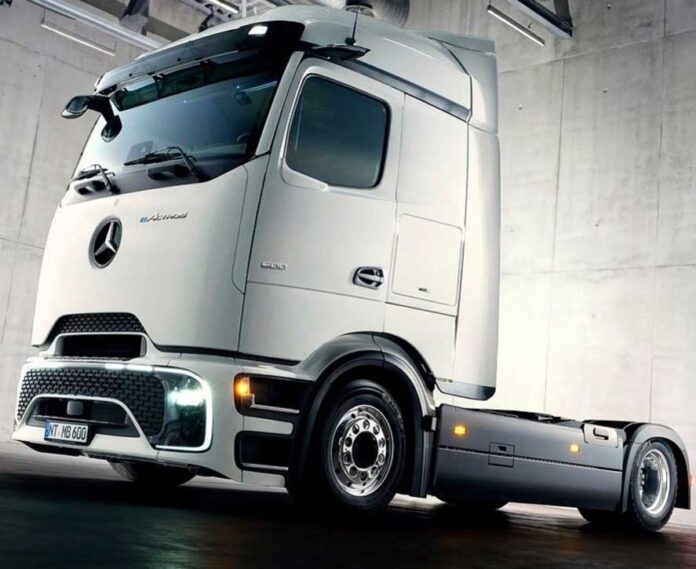
Mercedes-Benz Trucks has expanded its electric truck portfolio with the introduction of the new eActros Lowliner, a variant specifically designed for high-volume transport operations. Available with either two or three battery packs, the new model broadens the company’s range of battery-electric commercial vehicles and addresses the growing demand for locally CO₂e-free transportation solutions in the volume-intensive long-haul logistics sector.
The eActros Lowliner is scheduled to be available for order from the third quarter of 2026 across EU30 markets and selected additional regions, with series production set to begin in the second quarter of 2027 at Mercedes-Benz Trucks’ Wörth am Rhein manufacturing facility. The company will present detailed information about the new electric truck variant at the IAA Transportation exhibition in September 2026.
A Lowliner truck is a tractor unit with a particularly low coupling height, enabling the transport of trailers with increased interior volume. These transports, commonly referred to as volume transports, are designed for goods where space requirements are a key factor – especially tightly packed cargo such as boxed goods.
The Lowliner is based on the overall technological concept of the eActros 600, which has been in series production and in customer operation since late 2024. As early as fall 2025, Mercedes‑Benz Trucks significantly expanded the eActros model range based on the eActros 600. Depending on the application profile and requirements for payload and range, customers can now choose from around 40 variants derived from the base vehicle, including the eActros 400 with two instead of three battery packs.
Achim Puchert, CEO Mercedes‑Benz Trucks: “The eActros Lowliner marks the next step in the expansion of our battery‑electric long‑haul portfolio. It is consistently designed for high‑volume transport with mega trailers and is based on the proven technology of the eActros 600. This significantly broadens the range of applications available to our customers once again.”
Like all other models in the current eActros portfolio, the new Lowliner variant of the second eActros generation features the same core technological attributes, combining advanced drive technology with high energy efficiency. These include the in‑house‑developed electric drive axle, lithium iron phosphate (LFP) cell technology known for its long service life and more than 95 percent usable battery capacity, the 800‑volt onboard electrical system, the Multimedia Cockpit Interactive 2, and comprehensive driver assistance systems for enhanced safety(1).
High‑performance configuration
The Mercedes‑Benz eActros Lowliner is offered as a 4×2 tractor unit with a 4,000‑mm wheelbase and meets coupling heights and ground clearance comparable to diesel trucks. This allows mega trailers to comply with the legally permitted overall height while providing maximum possible interior height for volume‑intensive transport operations. With these dimensions, Mercedes‑Benz Trucks aligns the electric Lowliner with its diesel counterparts, enabling seamless integration of electric vehicles into existing fleets.
The new eActros Lowliner is available with either two or three LFP battery packs, each rated at 207 kWh(2). This results in an installed battery capacity of 414 kWh(2) for the eActros 400 Lowliner and 621 kWh(2) for the eActros 600 Lowliner. The range of the eActros 600 Lowliner is approximately on par with that of the standard eActros 600, which achieves a range of 500 kilometers(3) without intermediate charging when operated with three battery packs and a gross combination weight of 40 metric tons.
The eActros 400 Lowliner, equipped with two battery packs, has a lower vehicle weight and therefore offers a higher payload than the eActros 600 Lowliner with three battery packs. Thanks to the weight reduction, the maximum payload of the eActros 400 Lowliner increases to up to 24 metric tons, compared with up to 21 metric tons for the eActros 600 Lowliner.
Charging for the Lowliner variants – like all eActros vehicles – is possible at up to 400 kW via the standard CCS2 charging port on the left‑hand side of the vehicle. Charging two battery packs from 10 to 80 percent takes around 46 minutes(4), while charging three battery packs takes approximately 70 minutes(4). In addition to CCS charging, both eActros Lowliner variants will later support megawatt charging (MCS). For this purpose, an additional MCS charging port on the left‑hand side of the vehicle can be ordered as an option.
Integrated e‑axle and predictive powertrain control
Like the other vehicles in the eActros portfolio, the eActros Lowliner is equipped with the e‑axle from the eActros 600, featuring two electric motors and a four‑speed transmission. The electric motors deliver a continuous output of 400 kW and a peak output of 600 kW. Full motor power is available almost continuously, with virtually no interruption in torque.
Predictive driving enables energy to be recovered through recuperation and stored in the batteries for later propulsion. Recuperation also reduces brake wear by lowering the load on the braking system. Depending on the driving situation, the driver can choose between five different recuperation levels. One‑pedal driving – deceleration via recuperation with reduced use of the mechanical brake – can also be activated via the touchscreen in the digital cockpit.
The eActros Lowliner is likewise equipped with Predictive Powertrain Control, a cruise control and transmission management system specifically optimized for electric drivetrains. This predictive powertrain control automatically takes topography, road layout, and traffic signs into account to ensure the most efficient driving style possible. Route information from the navigation system is now also integrated, enabling improved anticipation of upcoming road events. This helps the driver reduce or ideally avoid unnecessary braking and acceleration, allowing battery energy to be used more efficiently.