
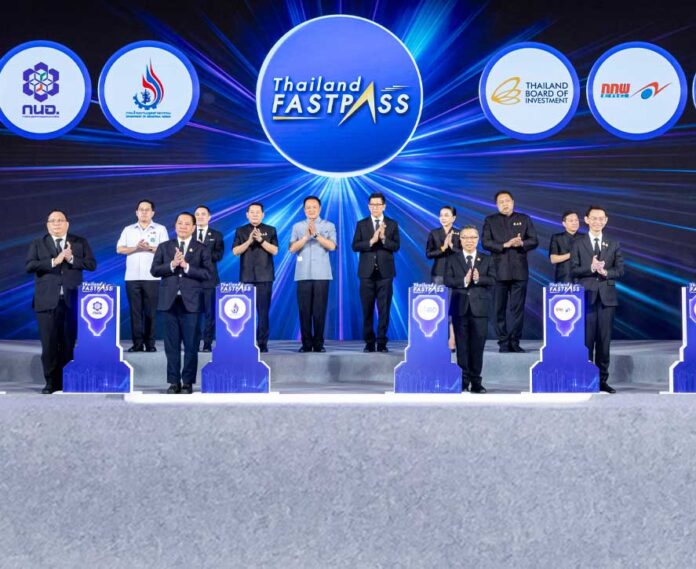
Thailand has unveiled the FastPass program, a major investment facilitation initiative designed to accelerate the development of strategic high-technology industries and attract investments worth more than USD 21 billion (approximately THB 700 billion). The program was officially launched by Prime Minister Anutin Charnvirakul at Government House.
The FastPass initiative brings together eight government agencies under a unified framework aimed at streamlining regulatory processes and reducing approval timelines by up to 50 percent. By simplifying procedures and improving inter-agency coordination, the program is expected to help approved projects move more quickly from the licensing stage to full-scale manufacturing operations.
The initiative is focused on attracting investments in high-value sectors critical to Thailand’s industrial transformation, including advanced electronics, aerospace technologies, precision machinery, automation systems, and recycled plastics. Through FastPass, the government aims to strengthen the country’s competitiveness as a regional hub for advanced manufacturing and innovation while supporting sustainable economic growth and technological development.
By coordinating eight key government agencies—including Thailand’s Board of Investment (BOI), the Department of Industrial Works, the Customs Department, the Office of Natural Resources and Environmental Policy and Planning (ONEP), the Industrial Estate Authority of Thailand (IEAT), the Energy Regulatory Commission, the Metropolitan Electricity Authority, and the Provincial Electricity Authority—the initiative removes historical friction in permitting, environmental approvals, and infrastructure connectivity.
At the ceremony, the eight agencies formalized their coordination by signing a memorandum of understanding (MOU) committing to reduce approval and licensing timelines by 20 to 50 percent across key investment milestones, including factory permits, free-zone processing, environmental impact assessments, and power grid connections.
The ceremony drew more than 300 attendees, including foreign diplomats, international chambers of commerce, and multinational executives.
“In today’s global economy, speed is the ultimate competitive differentiator,” said Mr. Anutin Charnvirakul, Prime Minister of Thailand. “The Thai government is shifting from regulator to active business facilitator. By removing regulatory hurdles, increasing speed, and ensuring policy transparency, we are driving physical investments that will generate next-generation employment and secure Thailand’s long-term regional competitiveness.”
The push to turn approved projects into physical factories follows a historic surge in investment applications. BOI received a record USD 54.5 billion (approximately 1.8 trillion baht) in investment applications in 2025. Momentum has carried into 2026, with first-quarter applications already exceeding USD 30.3 billion (approximately 1 trillion baht).
The USD 21 billion total spans two FastPass cohorts. In the first phase, FastPass resolved regulatory bottlenecks for 76 previously approved projects valued at over USD 14.4 billion (approximately 474 billion baht). Today’s ceremony launched the second cohort: 25 projects from 23 companies worth USD 6.7 billion (approximately 223 billion baht), each receiving a formal Thailand FastPass certificate.
“We are focusing heavily on ‘realized investment’ entering the actual economy,” said Mr. Ekniti Nitithanprapas, Deputy Prime Minister and Minister of Finance. “The FastPass mechanism is designed to deliver immediate, concrete economic results in the short term, while laying down long-term structural benefits that will distribute wealth across our broader economy. These 25 pilot projects from 23 companies are projected to generate over 13,000 high-skilled jobs. Combined with the 76 projects cleared under FastPass in the preceding phase, total investment mobilized by the program exceeds 700 billion baht.”
This mechanism converts corporate capital into domestic benefits across five key dimensions: driving investment-led GDP growth, generating high-skilled careers, transferring technical know-how, integrating local SMEs, and creating localized economic multipliers within regional communities.
“The FastPass program fundamentally changes how Thailand works with global investors,” said Mr. Narit Therdsteerasukdi, Secretary-General of the BOI. “We put eight agencies into one pipeline. Permit timelines that once stretched for months can now be cut by up to half. That gets factories built, creates high-skilled jobs, and pulls Thai suppliers into global supply chains.”
Global corporations participating in the FastPass program cited Thailand’s strategic location, modern infrastructure, robust supply chains, skilled workforce, and favorable investment policies as the key drivers for their expansion.
“Thailand possesses the talent, infrastructure, and policy support necessary for next-generation industries,” said Mr. Simon Gwozdz, CEO of Equatorial Space (Thailand) Co., Ltd., a developer of low-Earth orbit space launch vehicles. “The BOI’s one-stop coordination significantly reduces regulatory complexity.”
“The availability of raw materials, infrastructure, and proactive government support were critical in our decision to anchor our regional operations here,” said Mr. Donald Carpenter, CFO of U.S.-based PureCycle Technologies, Inc. “The FastPass mechanism directly improves our operational efficiency.”
“The speed of obtaining factory licenses under the scheme has accelerated our operational readiness, creating a smoother path to scale,” saidMr. Larry Foo of SAM Precision (Thailand), a Malaysia-based manufacturer of precision components for the semiconductor industry.
“The depth of Thailand’s electronics supply chain and supportive state policies were critical to our investment decision,” said Mr. Kris Leetavorn, Director of Advanced Connection Technology, a high-density printed circuit board (PCB) manufacturer. “The FastPass program drastically simplifies state coordination, allowing us to hit aggressive deployment timelines.”
To demonstrate Thailand’s readiness for advanced industries, the government showcased technologies currently being deployed or manufactured in Thailand, including humanoid robotics, LiDAR sensor systems, aerospace technology, and advanced electronics.
“Thailand FastPass proves what is possible when all agencies move in the same direction—approved investments actually get built,” Mr. Narit concluded. “The world is reshuffling supply chains. Investors need clarity and speed. Thailand is ready to deliver both. We will keep expanding FastPass to cover more permits and more strategic industries, creating quality jobs, strengthening supply chains, and raising Thailand’s long-term competitiveness.”