
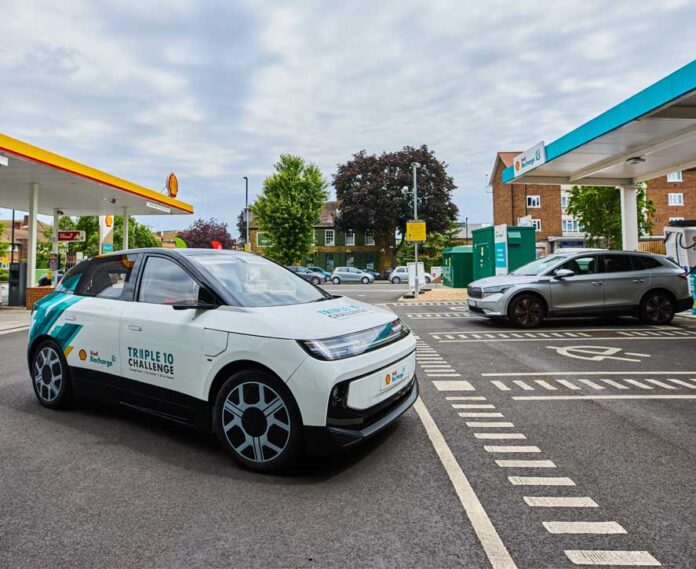
Shell has unveiled its innovative Triple 10 Challenge concept car, a proof-of-concept electric vehicle designed to showcase a new approach to battery electric vehicle (BEV) development. Co-engineered with industry partners, the compact mass-market EV demonstrates how advanced thermal management technologies can enable faster charging, greater energy efficiency, and significantly lower lifecycle emissions without relying on larger battery packs.
The concept vehicle has been developed around three ambitious performance targets, which Shell believes could shape the future of mainstream electric mobility:
- Charging from 10% to 80% in under 10 minutes
- Delivering an energy efficiency of 10 km per kWh
- Achieving a lifecycle carbon footprint of approximately 10 tonnes of CO₂ equivalent
According to Shell, the Triple 10 Challenge concept is the first road-worthy vehicle to successfully demonstrate a simplified single-circuit cooling architecture capable of managing the thermal demands of the entire powertrain, including the battery, motor, and power electronics, even during extreme fast-charging conditions.
Cara Tredget, Vice President, Mobility & Lubricants Technology at Shell, said the project demonstrates how advanced thermal fluids can unlock new possibilities for EV development.
“With the Triple 10 Challenge concept car, we have unlocked the potential for faster charging, lighter systems and improved lifecycle efficiency through the use of advanced thermal fluids. Together with our co-engineering partners, we are proud to develop scalable solutions that can support the future of sustainable electric mobility,” she said.
Designed for Greater Efficiency
The vehicle has been engineered to achieve an energy consumption figure of 10 km/kWh using a smaller and more efficient battery system. Shell claims this represents more than a 30% improvement in overall energy efficiency compared with many current-generation electric vehicles.
A key highlight is its fast-charging capability. The concept vehicle can charge from 10% to 80% state of charge in just 9 minutes and 54 seconds while maintaining battery thermal stability and longevity. Unlike some existing EVs that require ultra-fast chargers exceeding 300 kW to achieve similar charging times, the Triple 10 Challenge vehicle reaches this milestone using a more commonly available 175 kW charger.
The vehicle is capable of adding approximately 24 km of driving range per minute of charging, compared with an average of around 13 km per minute for conventional battery electric vehicles using the same charging infrastructure.
Lower Lifecycle Emissions
Shell estimates the concept vehicle’s total lifecycle carbon footprint at around 10 tonnes of CO₂ equivalent. This reduction has been achieved through a lightweight vehicle architecture, optimized battery capacity, the use of low-carbon and recyclable materials, and charging powered by 100% renewable electricity.
The company estimates that the concept could reduce lifecycle emissions by nearly 50% compared with typical battery electric vehicles currently sold in the European market.
Immersion Cooling Technology at the Core
At the heart of the vehicle is Shell Recharge thermal fluid, a dielectric fluid designed for direct immersion cooling. Unlike traditional water-glycol cooling systems, the fluid enables battery cells, electric motors, and power electronics to be immersed directly in the coolant, improving heat transfer efficiency across the powertrain.
This advanced thermal management approach allows for a more compact battery design, simplified cooling architecture, reduced system weight, and improved charging performance.
The concept car was unveiled at HORIBA MIRA’s proving ground and represents the culmination of Shell’s Triple 10 Challenge initiative. Shell claims the combination of a more compact battery pack, fewer modules, and simplified housing architecture contributes to an estimated 25% reduction in battery pack costs compared with a conventional electric vehicle.
Shell Consolidates EV Solutions Under Shell Recharge
Alongside the concept vehicle reveal, Shell announced that it is bringing together its electric mobility offerings under the Shell Recharge brand. The integrated portfolio will include charging infrastructure, thermal fluids, battery technologies, and energy solutions, creating a unified end-to-end EV ecosystem for both business and consumer customers.
As part of this consolidation strategy, the company confirmed that the Shell EV-Plus brand will be phased out.