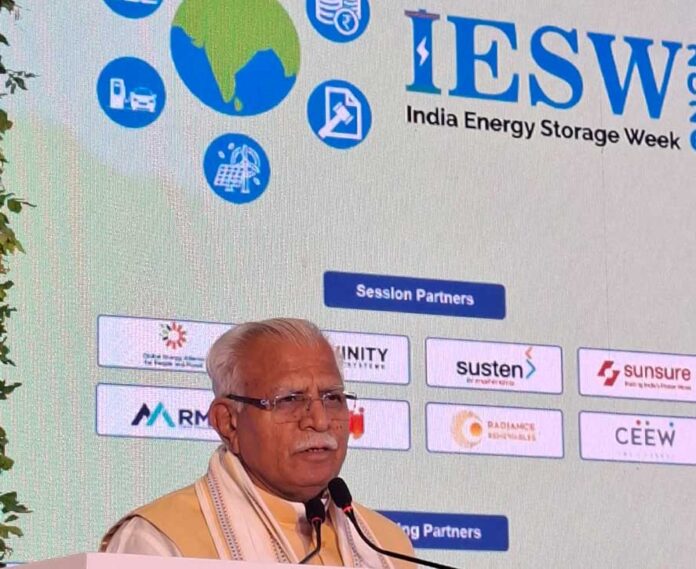
India’s peak power demand is projected to touch 300 GW next year, driven by the rapid growth of data centres, artificial intelligence (AI), and electric vehicles (EVs), Union Power Minister Manohar Lal said at the 12th India Energy Storage Week (IESW) 2026 held at Yashobhoomi in New Delhi.
Addressing the event, the minister said India’s peak power demand has already reached an estimated 271 GW and could rise further this year. He added that the country’s available generation capacity has increased to 284 GW, enabling it to meet rising electricity demand across sectors.
“We must prepare for a peak demand of 300 GW next year as electrification accelerates across the country,” Manohar Lal said.
The minister highlighted India’s significant progress in expanding its power generation capacity, which has grown from 249 GW in 2014 to 445 GW at present. He also noted that the country’s installed solar power capacity has increased fifty-fold over the past 12 years, reaching 137 GW.
Emphasising the growing importance of energy storage, Manohar Lal said it has become a national priority to ensure that electricity generated from renewable sources can be stored and supplied whenever and wherever required.
Reflecting on India’s evolving energy landscape, the minister said the concept of energy has shifted from immediate consumption to efficient storage and flexible usage. “Earlier, electricity had to be consumed as soon as it was generated. Today, with advanced energy storage technologies and modern grid solutions, power can be stored and used according to demand,” he said.
Manohar Lal also highlighted India’s long-standing leadership in pumped storage projects, noting that the country has been developing such infrastructure since 1923. He added that energy storage will play a crucial role in balancing variable renewable energy generation with round-the-clock electricity demand, supporting India’s clean energy transition.
Shri Manohar further emphasized the country’s commitment to environmental reforms and net-zero carbon emissions by 2070, noting that non-fossil fuel capacity has soared from 81 GW to 291 GW in just over a decade. “Solar, which was just 3 GW twelve years ago, is now at 137 GW, a 50x growth. But as much as solar has grown, we must invest in storage to truly harness its potential, targeting peak hours and ensuring energy is available 24/7,” he said.
The Minister also underscored the necessity of indigenization and self-reliance: “Nothing is greater than the country. Even if domestic products cost more initially, they belong to India. By manufacturing within our borders, we reduce imports, lower costs over time, and secure our nation against global uncertainties. ‘Vocal for Local’ and ‘Make in India’ are crucial for our power sector, especially in solar cells, batteries, and containers.”
Touching on global collaborations, the minister referenced the ‘One Sun, One World, One Grid’ vision, highlighting India’s efforts to build transnational green energy corridors, including a proposed 1,600-kilometre undersea cable to the UAE with an estimated cost of ₹40,000 crore, and expansion plans for connections to Sri Lanka, Singapore, and even Europe. He emphasized, “As the world moves to green energy, India’s leadership in storage, manufacturing, and R&D will benefit not just the nation, but the world.”
The Minister applauded key government policy initiatives such as the ISTS charges waiver, streamlined building guidelines, Time of Day tariffs, and green open access rules, all designed to encourage renewable energy adoption, support market access for generators, and benefit consumers.
Vinayak Walimbe, Managing Director, Customized Energy Solutions, said, “The scale and speed of India’s battery storage expansion is truly remarkable. This year alone, we’ve seen an 11-fold jump in installed BESS capacity and manufacturing announcements at levels that rival global leaders. The collaboration and vision on display at IESW 2026 confirm India’s emergence as a powerhouse for energy storage innovation and deployment.”
Organised by the India Energy Storage Alliance, the three-day event is expected to bring together over 200 exhibitors and more than 10,000 industry leaders for policy discussion, technical exchange, and announcements that will define India’s clean energy transition. The event features panels on gigafactories, grid modernisation, supply chain resilience, battery chemistries, recycling, and a dedicated track for women’s leadership in energy.
Ghanshyam Prasad, Chairperson, Central Electricity Authority (CEA), said, “India is targeting around 160 GW of storage by 2035, with clear roadmaps for both battery and pumped hydro storage. With robust infrastructure, strong private sector participation, and a renewed focus on domestic content and standardisation, we are laying the foundation for reliable, round-the-clock renewable energy. The stage is set; it’s time for the industry to deliver solutions for India’s clean energy future.”
As IESW 2026 continues, India’s energy storage sector stands at the heart of the nation’s clean energy revolution, powered by innovation, partnership, and a shared commitment to Atmanirbhar Bharat and global leadership.