
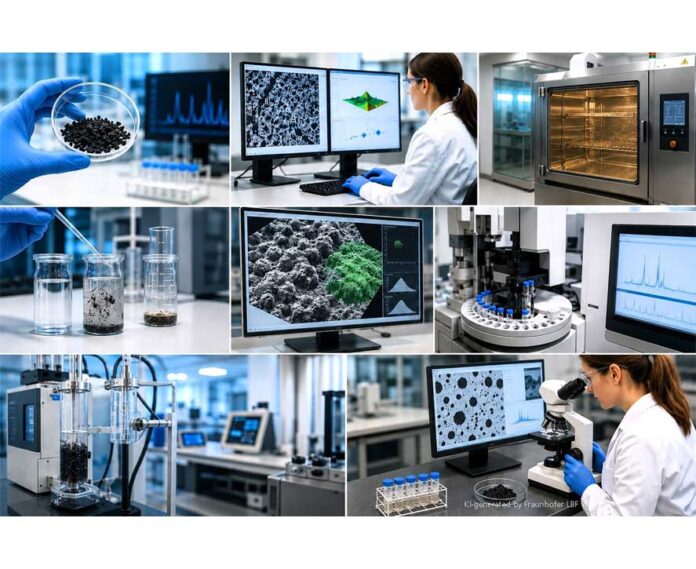
The Technology Platform for Tire Abrasion and the Identification of Its Emissions in Road Traffic (TERIS) project, led by the Fraunhofer Institute for Structural Durability and System Reliability (LBF) in collaboration with the Fraunhofer Institutes ICT, IGD and IWM, has achieved its first major milestone in developing standardized laboratory methods to analyse, measure and predict tyre wear and its environmental impact.
The project aims to create reliable and practical laboratory procedures that can accurately replicate real-world tyre abrasion, helping tyre manufacturers, testing laboratories and environmental agencies evaluate emissions more efficiently and support compliance with future regulations such as the Euro 7 standard.
New tools for tyre wear analysis
As part of the first milestone, researchers have successfully developed reference abrasion methods, particle analysis techniques, tribological models, AI-based surface analysis, a dedicated test bench concept, and methods for accelerated ageing and volatile organic compound (VOC) detection.
The milestone was formally reviewed and approved by an independent advisory board comprising industry experts, confirming that the project has successfully completed its first phase.
Simulating real-world tyre abrasion
The research team has combined multiple particle collection and measurement techniques to enable precise analysis of both airborne and deposited tyre wear particles. At the same time, new tribological models have been developed to better understand how load conditions, material properties, surface characteristics and friction influence particle generation during tyre wear.
These models enable researchers to reproduce real-world abrasion behaviour under controlled laboratory conditions, significantly improving the accuracy and repeatability of tyre wear testing.
AI-powered surface inspection
A key innovation of the TERIS project is the development of an artificial intelligence-based optical inspection system capable of automatically identifying and classifying tyre surface structures.
The system has already been validated using substitute materials and will be applied to real rubber compounds during the next phase of the project, allowing researchers to better understand the relationship between tyre surface characteristics and wear behaviour.
Accelerated ageing and emissions analysis
Researchers have also developed a specialised environmental test chamber capable of accelerating the ageing process of tyre materials under controlled environmental conditions. This allows engineers to study how weathering affects tyre wear and long-term performance within a much shorter timeframe.
In parallel, the project combines accelerated ageing with chemical analysis of volatile organic compounds (VOCs) released during tyre abrasion, enabling a more comprehensive assessment of the environmental impact of tyre wear particles.
Supporting future tyre development
The consortium has also designed a new laboratory test bench capable of generating tyre abrasion under multiaxial loading while simultaneously measuring emitted particles and integrating advanced optical sensing technologies.
According to the research team, these developments will enable faster and more reliable evaluation of new tyre compounds before they reach commercial production.
By providing robust laboratory testing methods, the TERIS project is expected to help tyre manufacturers reduce particulate emissions, accelerate product development, support regulatory compliance, and improve the environmental performance of future tyres under the upcoming Euro 7 emission framework.