India’s automobile industry kicked off FY2026-27 on a strong note, with passenger vehicles (PVs), commercial vehicles (CVs) and three-wheelers recording their highest-ever first-quarter sales. Exports across all major vehicle segments also reached record levels despite geopolitical uncertainties in West Asia, according to data released by the Society of Indian Automobile Manufacturers (SIAM) on Wednesday.
Passenger vehicle sales rose 25.9 per cent year-on-year to 12,73,811 units during the April-June quarter, marking the highest-ever first-quarter performance for the segment.
Utility vehicles continued to dominate the passenger vehicle market, with sales rising 28.6 per cent to 8,61,918 units, significantly outperforming passenger cars, which registered a 21.3 per cent increase to 3,67,549 units.
Passenger vehicle exports also touched a record high of 2.22 lakh units, up 8.8 per cent year-on-year. SIAM attributed the growth to strong demand from Latin America and improving shipments to Europe and Japan, although exports to the Middle East remained under pressure due to ongoing geopolitical challenges.
The two-wheeler segment also posted healthy growth, with domestic sales increasing 20.3 per cent during the quarter. Scooter sales continued to outperform motorcycles, supported by the momentum generated following lower GST rates.
Two-wheeler exports surged 36.6 per cent to a record 1.55 million units, driven by stable demand from South Asia and Africa, along with strong growth in Latin American markets.
Three-wheelers delivered their best-ever first-quarter performance, with domestic sales rising 29.7 per cent, supported by healthy demand across both passenger and goods carrier categories. SIAM said improving economic activity and easier financing availability in urban markets contributed to the segment’s strong performance.
Exports of three-wheelers climbed 57.7 per cent year-on-year to a record 1.51 lakh units during the quarter.
Commercial vehicles also registered their highest-ever first-quarter sales, reaching 2.65 lakh units, an increase of 18.3 per cent over the corresponding period last year.
Within the commercial vehicle segment, goods carriers recorded double-digit growth, supported by replacement demand and sustained activity in the mining and cement sectors, while passenger carriers posted modest growth. Commercial vehicle exports rose 43.3 per cent to nearly 28,000 units, the highest-ever first-quarter export performance, driven primarily by growing demand for pickup trucks in Southeast Asia.
June 2026 Performance
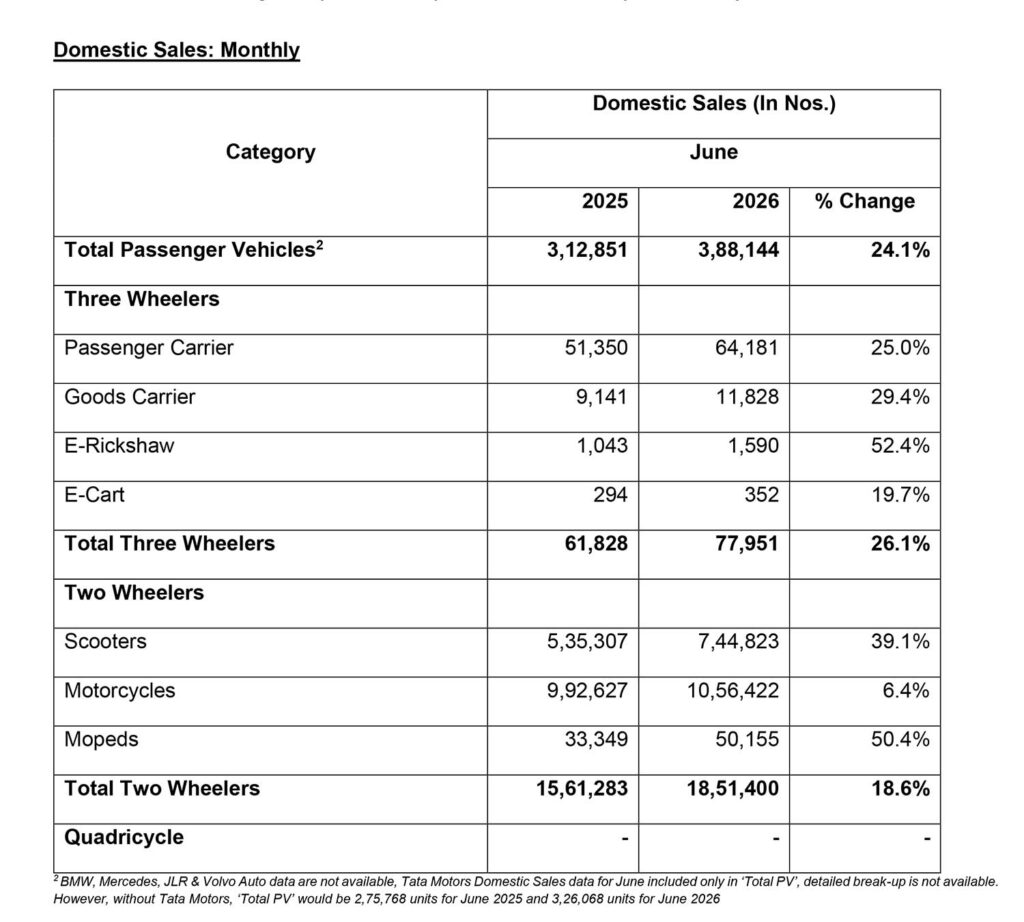
During June 2026, passenger vehicle sales increased 24.1 per cent year-on-year to 3,88,144 units, compared with 3,12,851 units in June 2025.
Two-wheeler sales reached 18,51,400 units, while three-wheeler sales stood at 77,951 units during the month.
Industry Outlook Remains Positive
Commenting on the quarterly performance, SIAM President Shailesh Chandra said the industry delivered robust growth despite supply chain disruptions arising from tensions in West Asia.
“Passenger vehicles, commercial vehicles and three-wheelers posted their highest-ever first-quarter sales, while all vehicle segments, including two-wheelers, recorded their highest-ever exports during the quarter,” he said.
Chandra attributed the strong performance to healthy domestic demand, lower GST rates, softer financing costs, the low base effect and the launch of several new vehicle models.
Rajesh Menon, Director General, SIAM, said, “High double-digit growth was recorded across all vehicle segments in the first quarter of FY2026-27 compared to the corresponding quarter of the previous financial year.”
Looking ahead, SIAM expects demand to remain healthy during the July-September quarter as the festive season approaches. Lower GST rates and favourable financing conditions are expected to continue supporting vehicle purchases.
However, the industry cautioned that volatility in commodity prices remains a key concern. While the earlier ceasefire in West Asia had eased pressure on fuel and raw material supplies, manufacturers continue to closely monitor the evolving geopolitical situation. The progress of the monsoon will also remain a crucial factor, given its direct impact on agricultural output and rural demand, both of which play a significant role in sustaining automobile sales during the festive season.