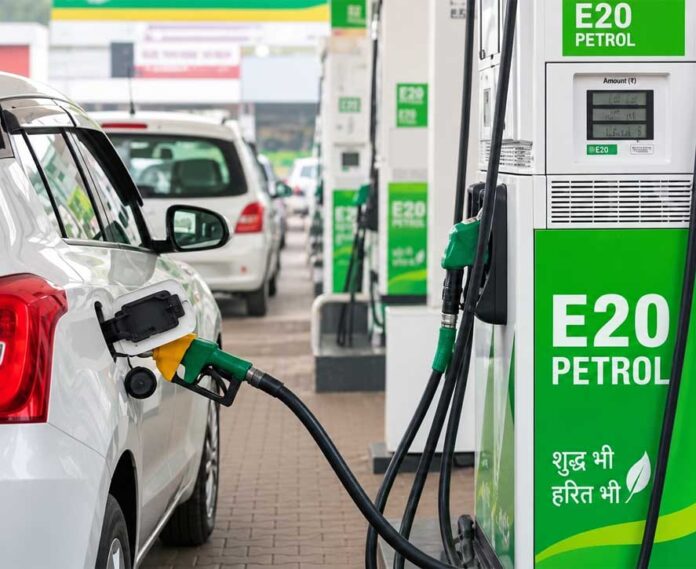
The government on Monday said there is no verified evidence linking E20 petrol to widespread engine failures or vehicle breakdowns, noting that more than 23 crore vehicles across India—including older models not certified for E20—have been operating on ethanol-blended fuel without any proven issues. The clarification came in a written reply by Minister of State for Petroleum and Natural Gas Suresh Gopi in the Rajya Sabha, according to ANI.
The minister stated that over 20 crore two-wheelers and more than 3 crore petrol cars, including a significant number of vehicles manufactured before E20 certification, have been using ethanol-blended petrol “without any verified evidence of widespread engine failure or vehicle breakdown attributable to ethanol blending.”
According to the government, India’s transition to E20 petrol has been gradual, calibrated, and supported by scientific research. Ethanol blending has increased from 1.53% in 2013–14 to 20% in 2025–26, with each increase preceded by laboratory testing, durability trials, and field validation.
The Centre said these studies were conducted in consultation with NITI Aayog, the Automotive Research Association of India (ARAI), the Society of Indian Automobile Manufacturers (SIAM), the Indian Institute of Petroleum (IIP), oil marketing companies, and automobile manufacturers. The assessments covered engine durability, fuel system compatibility, corrosion resistance, drivability, emissions, fuel efficiency, and overall vehicle performance.
Supporting its position, the government cited service data from vehicle manufacturers. It said one leading passenger vehicle manufacturer serviced 2.84 crore vehicles during FY26, including 1.5 crore older, non-E20-certified vehicles, without reporting any damage attributable to E20 fuel. Similarly, a leading two-wheeler manufacturer reported no higher incidence of vehicle damage in models using E20 compared with earlier ethanol blends.
Addressing concerns over fuel economy, the government acknowledged that some older vehicles originally designed for E10 petrol may experience a 3–5% reduction in mileage. However, it said fuel efficiency is influenced by several factors, including driving conditions, driving habits, and vehicle maintenance. The Centre added that E20 petrol offers advantages such as a higher octane rating, improved anti-knock properties, cleaner combustion, and smoother engine operation.
The clarification comes amid continued public discussion over the nationwide rollout of E20 petrol, with some motorists reporting reduced fuel economy and engine-related concerns. The government reiterated that available scientific studies and industry data do not establish any link between E20 fuel and widespread engine damage in compatible vehicles.
The minister also informed Parliament that the government has not taken any decision to increase ethanol blending beyond the current 20% level. Any future move towards higher ethanol blends, he said, will only be considered after comprehensive scientific and technical evaluations and consultations with automobile manufacturers, oil marketing companies, and research institutions.
The Centre further clarified that there is no proposal to mandate the sale of non-blended or lower-blend petrol at select fuel stations, reaffirming its commitment to the phased implementation of cleaner and more sustainable fuels under the Ethanol Blended Petrol (EBP) Programme.