
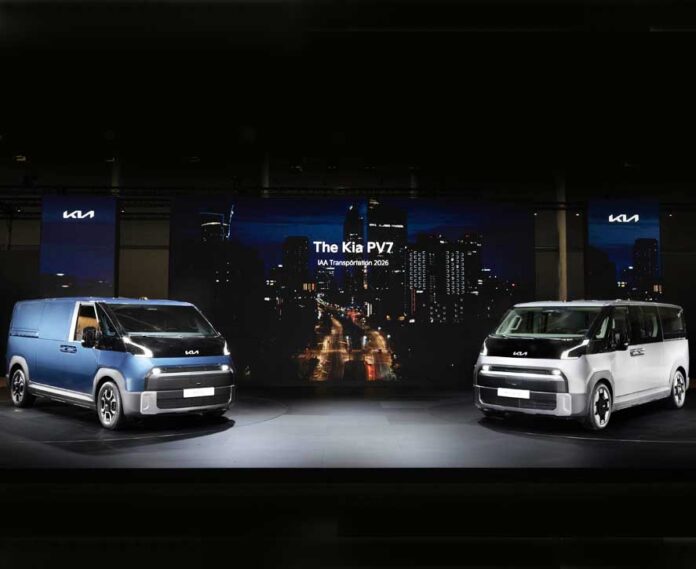
Kia Corporation has unveiled the PV7, the second model in its dedicated all-electric Platform Beyond Vehicle (PBV) lineup, at IAA Transportation 2026 in Hannover, Germany. Positioned above the PV5, the PV7 expands Kia’s presence in the light commercial vehicle (LCV) segment with a focus on greater space, flexibility, capability and business-oriented functionality.
The PV7 will be offered in Cargo and Passenger variants, catering to a broad range of applications including fleet and logistics operations, shuttle services, small and medium-sized businesses and personal mobility. Kia plans to launch the PV7 in South Korea and Europe in 2027, followed by additional derivatives and markets.
“The PV7 marks the next step in our journey toward personalized mobility, building on the foundation established by the PV5. By bringing together hardware developed for specific applications, business-tailored software and dedicated PBV services, the PV7 goes beyond the vehicle itself to deliver a complete business solution that helps customers achieve greater productivity, flexibility and long-term value,” said Ho Sung Song, President and CEO of Kia.
Kia PV7 Built on Dedicated E-GMP.S Architecture
The PV7 is based on Kia’s PBV-dedicated E-GMP.S architecture, which combines the company’s EV technology with an 800V charging system and a scalable drivetrain portfolio. The architecture incorporates a flat-floor layout designed to maximize interior space while allowing greater flexibility for different body configurations and applications.
Kia’s Flexible Body System enables the PV7 platform to accommodate multiple body styles, derivatives and conversion models. This allows the vehicle to be adapted to specific customer requirements and operational use cases.
The PV7 Passenger focuses on flexible seating arrangements and long-distance comfort, while the PV7 Cargo is designed around high load capacity, a low loading height and practical features aimed at commercial users.
Three-Pillar PBV Strategy
Kia’s PV7 strategy is structured around three key pillars: hardware, software and service.
On the hardware side, the vehicle combines its dedicated EV architecture with a flexible platform designed to support diverse applications. Kia aims to position the PV7 as a business-oriented mobility solution that can be configured according to individual operational requirements.
On the software front, Kia will provide its Kia Business Solutions Portal, offering functions related to fleet management, charging, maintenance and daily operations. Standardized Fleet Management Systems (FMS) and connected vehicle data APIs can provide customers with greater fleet visibility and support more efficient operations.
The company will also offer dedicated Uptime services, incorporating real-time monitoring, predictive diagnostics and proactive maintenance management. These systems are intended to help reduce operational disruptions and improve vehicle availability.
PV7 Designed for Greater Flexibility
The PV7 evolves Kia’s PBV design philosophy with bold, upright proportions and user-focused details aimed at maximizing interior space, accessibility and everyday usability.
Its flexible seating configuration and conversion capability allow the vehicle to serve multiple roles, while connected services and fleet-management solutions are designed to address the requirements of commercial operators.
Kia says its PBV-focused services are intended to provide tailored support across different business applications while helping customers manage operating costs and maintain higher vehicle uptime.
The PV7 builds on the foundation established by the PV5, which was named the 2026 International Van of the Year. With its larger dimensions and wider range of applications, the PV7 is intended to expand Kia’s reach across the commercial mobility sector.
“The PV7 has been developed to give customers the flexibility to adapt as needs evolve. As a business-tailored tool engineered to deliver best-in-class EV performance, data-driven solutions, and total service excellence, it will enable customers to improve work efficiency, enhance productivity, and create greater value throughout the business lifecycle,” said Sangdae Kim, Executive Vice President and Head of Kia’s PBV Business Division.
Kia Plans 23 PV7 Variants by 2027
Following the PV7’s launch in 2027, Kia plans to expand the model family to 23 variants, providing customers with a wider range of configurations and applications. The company also plans to introduce the PV9 in 2029, further expanding its dedicated PBV portfolio.
Kia is showcasing the PV7 alongside its wider PBV lineup to the public at IAA Transportation 2026 in Hannover from September 15 to 20, highlighting its strategy to combine electric vehicle hardware, connected technologies and dedicated services into integrated mobility solutions for commercial customers.