The government has notified the Gas Cylinder (Third Amendment) Rules, 2026, introducing a regulatory framework for CNG and compressed biogas (CBG) mobile refuelling units (MRUs). The new provisions specify requirements related to ownership, equipment, permitted applications, dispensing locations and safety systems.
The Department for Promotion of Industry and Internal Trade (DPIIT), Ministry of Commerce and Industry, issued the notification on September 21, 2026. The amended rules came into force from their final publication in the Official Gazette on September 23, 2026.
CNG and CBG MRU Ownership Requirements
Under the amended rules, a CNG MRU must be owned by a City Gas Distribution (CGD) company authorised for the relevant geographical area, while a CBG MRU must be owned by a licensee operating under Form E&F.
Both types of units must have an assembly approved by the Chief Controller, covering the storage cascade, dispensing system, piping, hoses, pressure-regulating devices, safety fittings, emergency shut-down (ESD) system, layout, operating procedures and emergency response arrangements.
The MRUs must also be equipped with a fail-safe, manually operated ESD system accessible from at least two locations. The system must be capable of isolating the cascade and dispensing lines, shutting off the CNG/CBG supply and immediately stopping dispensing operations. It must be periodically tested according to the manufacturer’s procedure.
Where CNG and CBG MRUs Can Dispense Fuel
The rules restrict MRU dispensing to approved onboard CNG/CBG cylinders fitted as fuel tanks. Permitted applications include:
- Non-transport vehicles operating within mines covered under the Mines Act or notified ports
- Indian Railways locomotives
- Approved ships and boats operating on inland or seaborne waterways
- Engines undergoing testing at testing laboratories authorised by the Central Government
The Chief Controller may, in exceptional circumstances, permit refuelling of heavy equipment, machinery or other heavy vehicles that cannot be brought to conventional fuel stations. Such approval can include additional safeguards, site inspections, risk assessments and other conditions.
MRUs can be filled or charged only at designated areas of CNG mother stations or licensed CNG/CBG filling premises. The units must be attached to the relevant licensed premises and reflected in its approved layout and licence.
The rules also prohibit MRUs from being used for public retail dispensing on public roads, residential areas, commercial parking areas, basements, enclosed premises or other locations that have not been specifically approved.
Safety Requirements for Mobile Refuelling Units
The amended rules prescribe minimum safety distances during CNG/CBG dispensing. MRUs with storage cascade capacities of up to 4,500 litres must maintain a minimum distance of four metres from buildings and boundaries, while units above 4,500 litres must maintain a minimum distance of five metres. The Chief Controller can prescribe greater distances from roads, ignition sources, overhead electrical lines, drains, basements and other vulnerable locations.
MRUs with a total water capacity exceeding 10,000 litres cannot be used without specific permission from the Chief Controller and additional safeguards.
The dispensing area must be physically protected and display warning signs in English, Hindi and the local language. Smoking, open flames, mobile phone use, hot work, unauthorised electrical equipment and public access are prohibited within the dispensing area.
Refuelling must take place under the direct supervision of an authorised and trained responsible person familiar with CNG/CBG hazards and the applicable safety requirements.
Cylinder, Hose and Coupling Standards
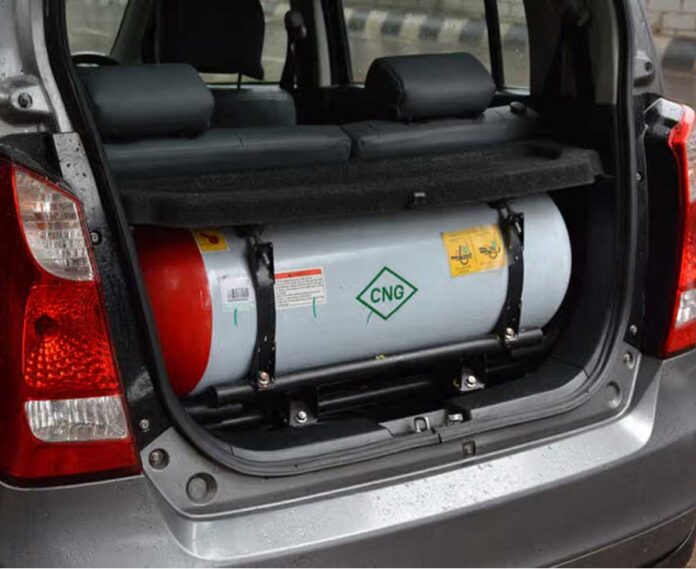
The storage cascade cylinders used by CNG/CBG MRUs must comply with specified standards, including IS-7285, ISO-9809 and ISO-11119, or another code accepted by the Chief Controller.
The maximum allowable working pressure is set at 250 bar gauge, unless a different pressure is specifically approved.
Hoses and couplings must be suitable for CNG/CBG service, mechanically and electrically continuous, and have a minimum burst pressure of four times the maximum operating pressure. They must also incorporate safety provisions such as breakaway couplings, excess-flow or quick shut-off arrangements, and bonding or earthing systems.
Vehicle Approval and Refuelling Procedures
Vehicles and equipment proposed for CNG/CBG refuelling must be vetted by the relevant competent authority, depending on the application. These may include the Directorate General of Mines Safety, port authorities, railway administration or the Inland Waterways Authority of India.
The approved list must be maintained at the site and updated before any new vehicle or equipment is refuelled.
Refuelling must be completely suspended while an MRU is being exchanged. Operators must close the relevant valves, depressurise the dispensing system where required and keep the ESD activated during the exchange operation.
Before dispensing begins, hoses, couplings, valves, dispensers and the receiving fuel system must be visually checked to ensure they are leak-free.
Emergency Planning and Record-Keeping
Each dispensing location must have a site-specific emergency plan, which must be submitted to the relevant authorities, displayed at the site, communicated to operators and tested through periodic mock drills. The dispensing area must also allow unhindered access for emergency vehicles, including fire tenders and ambulances.
The relevant CGD entity or licensee must maintain records covering MRU filling and dispensing, pressure readings, vehicle and equipment details, operator information, leak checks, ESD checks, hose testing, maintenance, defects, repairs and incidents.
The amended rules define a CNG/CBG MRU as a mobile assembly comprising storage, dispensing and associated safety equipment mounted on a vehicle, trailer, skid or another mobile platform for dispensing CNG/CBG into approved onboard fuel cylinders or fuel systems at specifically approved sites.
The new framework establishes specific operational and safety conditions for mobile CNG and CBG refuelling, while limiting their use to approved applications and locations.