Automechanika Frankfurt will offer 13 free hands-on training sessions on modern collision repair, organised in collaboration with leading automotive industry partners. The expanded programme now covers nearly the entire collision repair workflow, equipping workshop professionals with the latest skills and technologies shaping the industry.
The training sessions will span a wide range of topics, including damage assessment, repair cost estimation, body measurement, metalwork, plastic repairs, paintwork, glass repair, ADAS calibration, high-voltage vehicle safety, and AI-assisted robotic painting.
Held daily in Hall 11.0 during the exhibition, the sessions are open to all participants at no cost. Attendees will receive a certificate upon completion, while those who register in advance will also benefit from complimentary admission to Automechanika Frankfurt.
Highlighting the industry’s rapid transformation, Olaf Mußhoff, Director of Automechanika Frankfurt, said that repairing accident-damaged vehicles now requires a far broader skill set than ever before. He noted that advancements in digitalisation, advanced driver assistance systems (ADAS), alternative powertrains, and high-voltage technologies are fundamentally reshaping repair processes. Through these practical training programmes, Automechanika Frankfurt and its industry partners aim to provide workshops with the knowledge and expertise required to meet both current and future repair challenges.
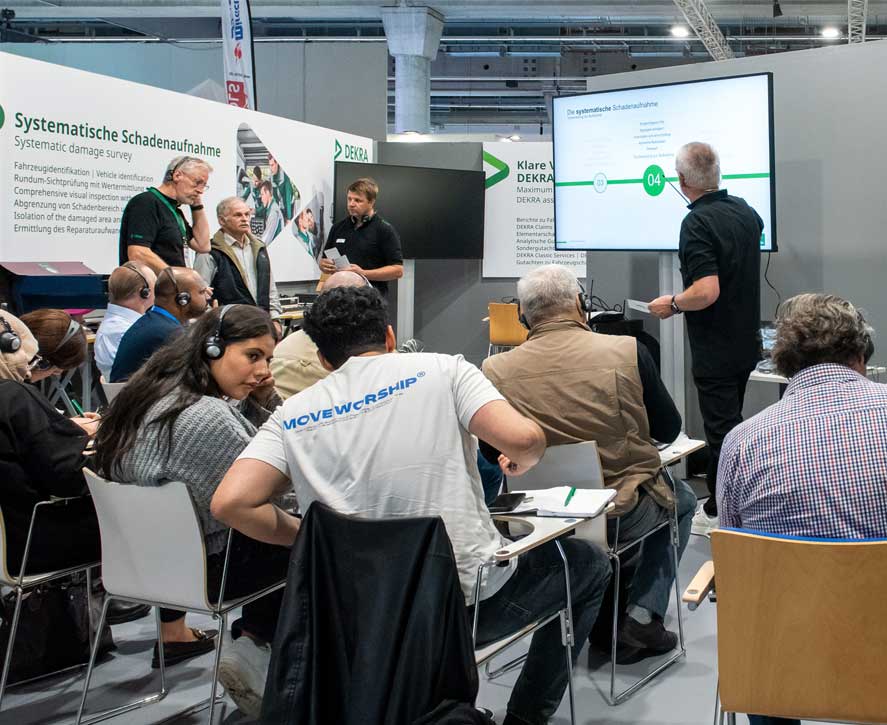
The programme begins with damage assessment and cost estimation, as well as bodywork measurement. In the training ‘Systematic damage assessment of cars involved in accidents’, DEKRA Automobil GmbH demonstrates how collision damage is systematically recorded and clearly documented. Deutsche Automobil Treuhand GmbH (DAT) is organising ‘Repair Cost Calculation with SilverDat3 – German engineering meets modern AI’. This session focuses on the efficient digital calculation of vehicle damage in day-to-day workshop practice. ‘Electronic body measurement for damage diagnosis’ is led by Car-O-Liner Deutschland GmbH and explains the interplay between straightening bench repairs and electronic body measurement.
The focus of the special repair techniques is on metal and plastic. In ‘Sustainable plastic repair of bumpers’, BETAG Innovation by Beulentechnik AG demonstrates how damaged bumpers can be repaired in a resource-efficient way. In ‘External body panel dent repair (steel, large areas)’, Carbon GmbH presents techniques for repairing large areas of steel damage to the bodywork. WS Wieländer+Schill GmbH & Co. KG explains in ‘Combined joining techniques (bonding, riveting, welding) – methods for process optimisation’ how bonding, riveting and welding can be combined reliably and efficiently.
Paintwork and glass form another key focus. For the first time, the Bundesverband Autoglaser e.V. (Federal Association of Independent Automotive Glaziers in Germany) is also taking part and, in its session ‘Modern vehicle glazing processes as an integrated system – from damage assessment to the calibration of ADAS components’, will showcase the entire process from initial damage assessment to the calibration of advanced driver assistance systems. In the training ‘Carrying out windscreen replacement professionally – vehicle glazing under time pressure – Mastering modern bonding’, the association explains how a professional windscreen replacement can be carried out safely, even under time pressure. In ‘Digital claims handling in vehicle glazing – faster estimates, reliable invoicing, avoiding Errors’, the Federal Association of Independent Automotive Glaziers in Germany demonstrates how digital processes can speed up the estimation and invoicing of glass damage and reduce errors. In ‘Tradition meets modernity – digitalisation & paintwork’, Surventis GmbH (formerly BASF Coatings GmbH) and Farécla Products Ltd. (Glasurit, Farécla) combine established paintwork practices with digital applications.
Modern vehicle technology and new automation solutions take centre stage in the trainings on ADAS diagnostics, alternative powertrains, as well as AI and robotics. In ‘ADAS calibration for vehicles with Level 2+, 3 and higher automated driving capabilities, and diagnostics with fault code reading’, Robert Bosch GmbH explains how modern driver assistance systems are calibrated and how faults can be diagnosed by reading the vehicle’s fault memory. The TAK Academy of the German Motor Trade and Toyota Deutschland GmbH will cover key safety measures for repairing high-voltage vehicles involved in accidents in their session ‘High-voltage safety in everyday workshop practice – Precautions for accident repairs’. SEHON innovative Lackieranlagen GmbH demonstrates in ‘The AI revolution – AI-assisted robotic painting for the trade’ how AI and robotics can support automotive refinishing processes.
Flexible formats for professionals and young talents
The trainings are available in one-hour and three-hour formats. The three-hour sessions combine extensive hands-on training with in-depth content, while the one-hour trainings provide a concise introduction and overview. All seminars will take place daily and run concurrently in German and English from 8 to 12 September. A special ‘Vocational School Day’ on Thursday, 10 September, is aimed specifically at vocational school classes, offering students valuable insights into various areas of collision repair.
The programme will once again be supported by renowned automotive experts Hans-Jürgen Faul and Holger Parsch, known as the ‘Autodoktoren’. The free trainings are aimed not only at professional mechanics, but also at specialists from across the industry – including motor vehicle assessors, service advisers and engineers – as well as the next generation of professionals. In addition to providing hands-on training on current topics and trends, the trainings offer an excellent opportunity to exchange ideas and network with other automotive professionals.
Please register online in advance at: automechanika.com/trainings.