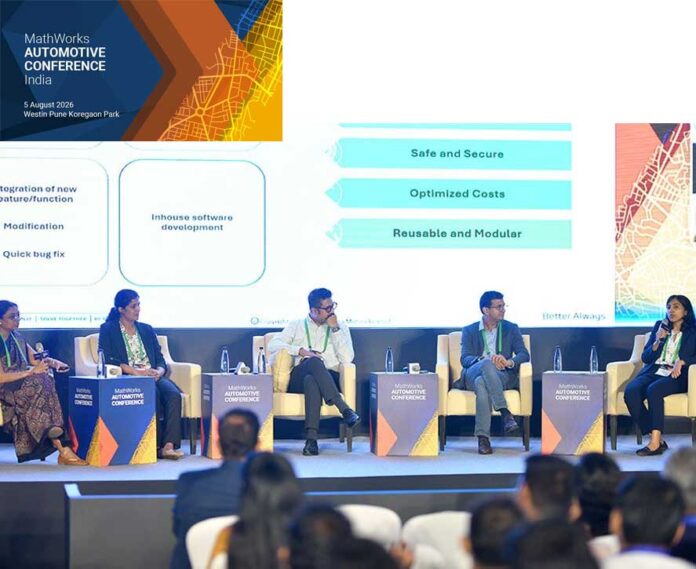
MathWorks successfully concluded the Automotive Conference 2026 India at The Westin Pune Koregaon Park, bringing together automotive engineers, researchers, industry experts, customers, technology partners and academic institutions to discuss the future of vehicle development through artificial intelligence and advanced engineering tools.
The conference focused on how Agentic AI, Model-Based Design, virtual engineering and simulation-driven development are transforming the automotive industry by enabling faster, more efficient and software-centric product development.
The event provided a platform for industry leaders to exchange ideas, showcase real-world engineering applications and discuss how AI-assisted development is accelerating innovation across the automotive value chain. Through expert sessions, customer case studies and collaborative discussions, participants explored the growing role of intelligent software, digital engineering and simulation in developing next-generation mobility solutions.
By bringing together stakeholders from across industry and academia, the conference reinforced the increasing importance of AI-powered engineering workflows in helping automotive companies improve product quality, reduce development time and accelerate the transition towards connected, autonomous and electrified vehicles.
Sessions explored how engineering organizations are combining AI agents, simulation, testing, verification, validation, and software development workflows across the automotive engineering lifecycle while maintaining engineering rigor, traceability, safety, and quality. Topics included scenario-based simulation for ADAS development, virtual vehicle workflows, and software-defined vehicle architectures supported by Model-Based Design.
The customer keynote by Piyush Agrawal, Executive Vice President, Maruti Suzuki India Limited, explored how the automotive industry is navigating an era of unprecedented transformation, where software, systems engineering, and disciplined engineering processes are becoming critical enablers of future mobility.
A keynote by Wensi Jin, Global Automotive Industry Manager, MathWorks, addressed how the combination of Model-Based Design and Agentic AI can help engineering teams manage increasing system complexity and improve productivity.
“MathWorks Automotive Conference 2026 India highlighted the growing interest in applying Agentic AI to automotive engineering workflows,” said Sunil Motwani, Country Manager – Sales and Service, MathWorks India. “The conversations reflected how organizations are moving beyond experimentation and exploring how AI agents can assist engineers throughout the development lifecycle while meeting the quality and safety requirements essential for automotive systems.”
Industry experts from Mahindra & Mahindra, Tata Elxsi, Madras Engineering Industries Pvt. Ltd., and several other organisations shared real-world applications of advanced engineering technologies during the conference. Presentations highlighted topics such as cloud-native simulation for large-scale virtual experiments, AI-assisted Model-Based Design, and virtual testing techniques that are helping accelerate automotive product development.
Technical sessions also explored the role of AI agents in supporting verification and validation activities, including model inspection, requirements analysis and software testing. These AI-enabled workflows are designed to improve engineering productivity while enhancing the accuracy and reliability of verification processes throughout the development lifecycle.
A panel discussion brought together industry leaders to examine the growing adoption of Agentic AI in automotive engineering. The conversation focused on governance frameworks, validation requirements and the changing role of engineers as software-defined vehicles and AI-driven development continue to reshape the industry.
Complementing the conference sessions, the Technology Showcase featured live demonstrations of AI-powered engineering solutions, including automated driving development, virtual vehicle engineering, software-defined vehicle architectures, battery thermal management system design and software factory workflows built using MATLAB and Simulink. The demonstrations showcased how digital engineering and simulation technologies are enabling faster innovation, improved collaboration and more efficient vehicle development.