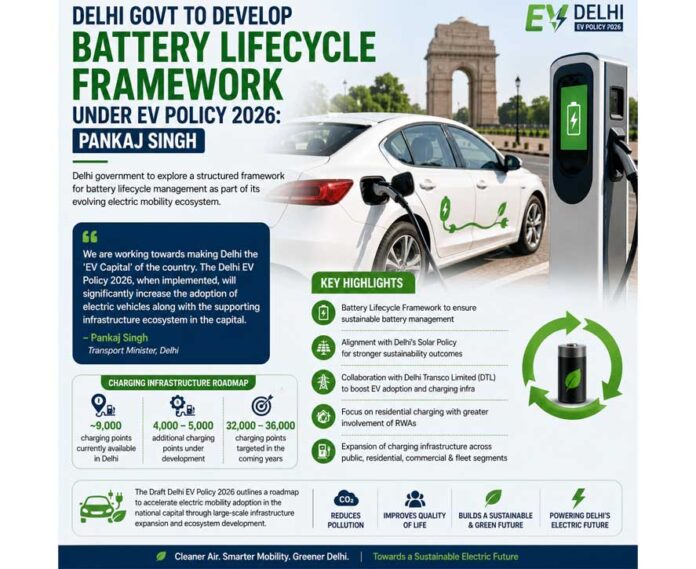
The Delhi government will explore a structured framework for battery lifecycle management as part of its evolving electric mobility ecosystem under the Draft Delhi EV Policy 2026, Transport Minister Pankaj Singh said on Friday during a stakeholder consultation.
According to PTI, the government convened a meeting with industry representatives and ecosystem participants to gather feedback on the draft policy. Several stakeholders also recommended aligning the EV policy with Delhi’s Solar Policy to strengthen overall sustainability outcomes.
“We are working towards making Delhi the ‘EV Capital’ of the country. The Delhi EV Policy 2026, when implemented, will significantly increase the adoption of electric vehicles along with the supporting infrastructure ecosystem in the capital,” Singh said. He added that the transition would help reduce pollution and improve the quality of life for citizens.
The consultation aimed to collect evidence-based inputs from industry players to refine and finalise the draft policy. Officials noted that participants included two-wheeler, three-wheeler, and four-wheeler manufacturers, power distribution companies, and other stakeholders from the EV ecosystem.
During discussions, industry representatives emphasized the need for coordination with Delhi Transco Limited (DTL) to accelerate EV adoption and enable the rollout of a robust public and private charging network. Residential charging infrastructure emerged as a key focus area, with calls for greater involvement of Resident Welfare Associations (RWAs) to address parking constraints and improve last-mile accessibility.
The expansion of charging infrastructure across public, residential, commercial, and fleet segments was also discussed. Delhi currently has around 9,000 charging points, with an additional 4,000–5,000 under development, while the city aims to scale up to 32,000–36,000 charging points in the coming years.
Stakeholders further highlighted the importance of mapping existing infrastructure in collaboration with original equipment manufacturers and operators to ensure efficient and coordinated deployment of charging assets.
The Draft Delhi EV Policy 2026, released earlier this month, outlines a roadmap to accelerate electric mobility adoption in the national capital through large-scale infrastructure expansion and ecosystem development.