
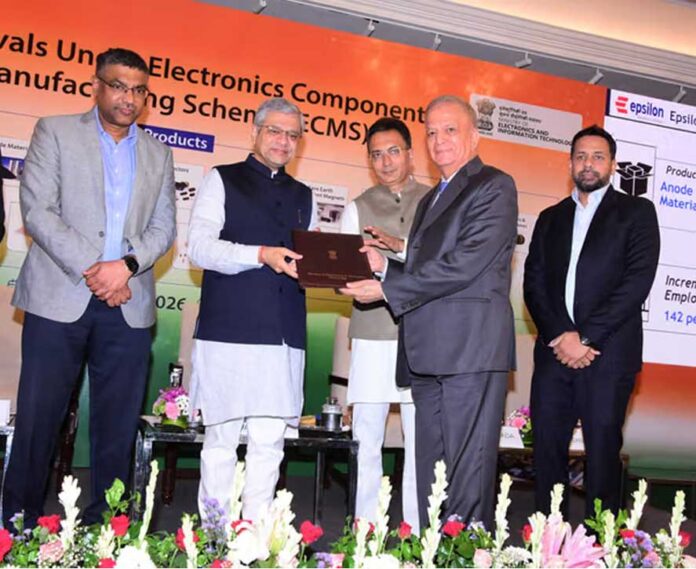
Epsilon Advanced Materials has received approval for its Epsilon C2GR anode material project under the Electronics Components Manufacturing Scheme (ECMS) of the Ministry of Electronics and Information Technology (MeitY). The project will receive ₹145 crore in capital expenditure support, equivalent to 25% of the planned investment.
According to Epsilon, it is the only company approved for anode material manufacturing in the latest tranche of ECMS approvals. The scheme has so far cleared 106 projects across 30 product categories, representing a combined investment of ₹69,548 crore and projected production worth ₹5.34 lakh crore.
The project aims to develop indigenous technology and establish large-scale manufacturing capabilities for graphite anode materials in India. The materials are expected to cater to growing demand from electric vehicles, energy storage systems, digital devices and consumer electronics.
Epsilon Targets 30,000 TPA Graphite Anode Capacity by 2028
Epsilon has already commissioned its EAM-ONE facility in Vijayanagar, Karnataka, which it describes as India’s first graphite anode material customer qualification plant.
The company is now progressing towards commercial-scale production and plans to increase its graphite anode manufacturing capacity to 30,000 tonnes per annum by 2028. A second phase is expected to take total capacity to 100,000 tonnes per annum.
Vikram Handa, Managing Director, Epsilon Group, said that building a resilient battery ecosystem requires ownership of technology, intellectual property, research and development, and process know-how.
Epsilon Expands Graphite Anode R&D
Epsilon’s graphite anode programme covers in-house R&D, material development, process optimisation and electrochemical validation. Its testing capabilities include coin-cell, pouch-cell and multi-layer pouch-cell formats.
The company has filed 43 patents covering process, product and equipment technologies and plans to develop another 50 intellectual property assets by 2030.
Through the project, Epsilon aims to increase domestic value addition in battery manufacturing while reducing India’s dependence on imported critical battery materials. The initiative also supports the development of a more self-reliant battery ecosystem as demand for EVs and energy storage continues to grow.