Hyundai Motor Company has outlined an ambitious global growth strategy through 2030, with India emerging as a key market and manufacturing hub. At its 2026 CEO Investor Day in Seoul, the South Korean automaker reaffirmed its target of achieving 5.55 million global vehicle sales and a 6 per cent global market share by the end of the decade.
As part of its India strategy, Hyundai plans to launch 26 models in the country by 2030 and expand local manufacturing capacity by 320,000 units. This forms part of the company’s broader plan to increase global manufacturing capacity by 1.27 million units by 2030.
Hyundai currently operates manufacturing facilities in India with an annual production capacity of 1.1 million units. By 2030, the company expects India to play an even larger role as an export hub, with around 30 per cent of locally produced vehicles earmarked for markets across the Middle East, Africa, Asia and South America.
The automaker also plans to increase locally sourced vehicle content in India to 90 per cent by 2030. This will be supported by a supplier network of more than 1,400 companies and a workforce of over 900 engineers in the country.
Hyundai to Expand EV Portfolio in India
Electrification will be a major focus of Hyundai’s future product strategy. The company plans to introduce a new electric SUV in India in the fourth quarter of 2026, further expanding its growing EV portfolio.
Globally, Hyundai is targeting electrified vehicles to account for 60 per cent of its sales by 2030, compared with 23 per cent in 2025. The company is also planning more than 100 new vehicle launches and model refreshes worldwide by 2030, including more than 18 entries into new products and market segments.
Hyundai has announced that seven new vehicles will be introduced globally over the next eight months. From the first half of 2027, the company will also begin launching Extended Range Electric Vehicle (EREV) models, targeting more than 600 miles of driving range.
India to Support Hyundai’s Global Expansion
Hyundai’s plans for India extend beyond domestic sales, with the country positioned as a strategic manufacturing and export base. The company expects increased production capacity and higher levels of local sourcing to strengthen India’s role in its global supply chain.
The automaker’s strategy comes as it seeks to balance volume growth with improved profitability. Hyundai has raised its 2030 operating profit margin target to above 9 per cent, up from its previous guidance of 8–9 per cent. The company expects this improvement to be supported by a three-percentage-point reduction in its cost-of-sales ratio.
For the first half of 2026, Hyundai reported revenue of 95.2 trillion won and an operating profit margin of 5.6 per cent, while its market capitalisation averaged around 105 trillion won year to date.
Broader Global Product and Technology Push
Hyundai is also expanding its presence across performance, luxury, robotics and autonomous driving. Hyundai N, its performance-focused division, is targeting annual sales of 100,000 units by 2030 and will be joined by a new volume-oriented high-performance tier.
Genesis, Hyundai Motor Company’s luxury brand, is entering its second decade with plans for its first hybrid, its first EREV and the flagship GV90 SUV. Genesis is targeting annual sales of 350,000 vehicles across more than 40 markets by 2030.
In the autonomous mobility space, Hyundai plans to begin deliveries of vehicles to Waymo in the fourth quarter of 2026, followed by U.S. robotaxi production from 2028 with annual capacity of 30,000 units.
The company is also developing its autonomous-driving capabilities in stages. Atria AI will begin real-world data collection in Korea this year, while Level 2+ autonomous driving is planned for Hyundai’s first mass-produced software-defined vehicle in 2028 in collaboration with NVIDIA. From 2029, Hyundai plans to bring a 100-megawatt AI data centre online with more than 50,000 GPUs.
Battery technology will also play a central role in Hyundai’s electrification strategy. The company’s in-house battery cells are claimed to deliver more than twice the output of its previous high-nickel cells while enabling 40 per cent faster charging. New Thermal Runaway Protection technology will debut on the Genesis GV90.
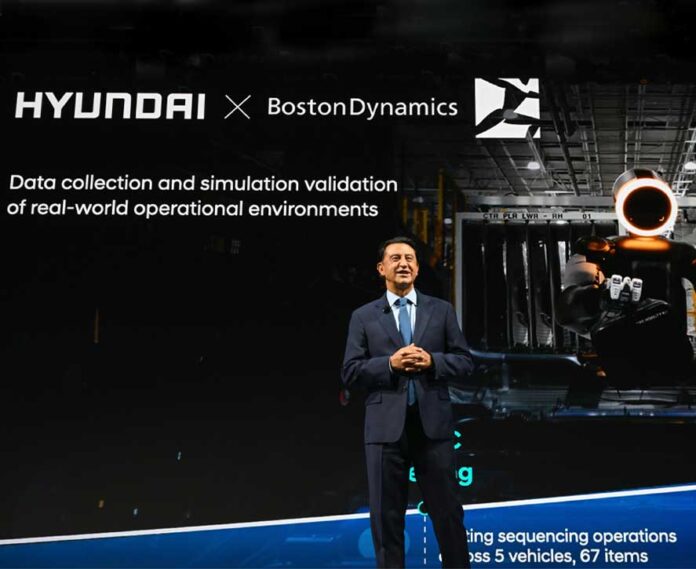
Hyundai is simultaneously expanding its robotics ambitions through Boston Dynamics, exploring opportunities in robot distribution and financing, while targeting a tenfold expansion of RMAC by the end of 2026.
With 26 new models planned for India by 2030, increased production capacity and a stronger focus on electrification and exports, Hyundai is positioning India as a critical pillar of its global growth strategy for the remainder of the decade.