
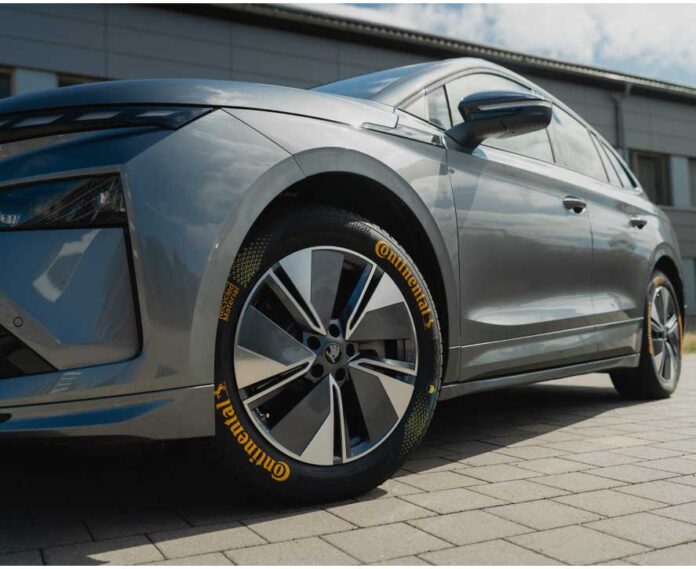
As part of the EU-funded ZEvRA project, Continental has developed a concept tire made from around 43 percent recycled materials. The concept tire highlights the potential of innovative material approaches. It also demonstrates the need for a reliable framework when adopting recycling technologies on an industrial scale.
“Circular materials can help save resources and energy while reducing greenhouse gas emissions. They are key to making mobility more sustainable,” says Dr. Andreas Topp, head of Platform Development and Industrialization for passenger-car tires at Continental. “We have extensive experience in developing high-performance materials from renewable and recycled sources. Our concept tire shows what is technically possible today – while serving as a catalyst for the innovations of tomorrow,” he adds.
The project name ZEvRA stands for “Zero Emission Electric Vehicles Enabled by Harmonized Circularity.” The two-year EU project that will conclude in 2026 is aimed at optimizing the circular economy of electric vehicles along the entire value chain. Continental is the only tire manufacturer in the consortium.
Tires consist of numerous high-performance raw materials which are precisely balanced to ensure safety, efficiency and longevity. These complex technical requirements make circularity particularly challenging. Incorporating a high percentage of recycled materials into a safety-critical product while still meeting high performance standards therefore constitutes a significant step forward. The concept tire demonstrates the compatibility of sustainability and performance, achieving the highest rating for the EU rolling resistance label.
Clear regulatory frameworks are essential
Recovered carbon black is one example of a recycling solution that is already in effective use today. At the same time, there are many processes still in industrialization. “The ZEvRA project shows that technological progress can only achieve its full impact when reliable, aligned frameworks provide planning certainty and support the market ramp-up of new processes,” Topp explains. This requires standard European-wide definitions for recycled materials, as well as clearly defined criteria stipulating when processed substances are classified as recycled raw materials. Technological openness and ongoing development of recycling technologies and associated infrastructures are just as important if high-quality recycled raw materials are to be made available in sufficient quantities. Resilient supply chains and internationally coordinated procedures for material flow allocation are also crucial for the widespread use of recycled materials.
Continental says the next step is to scale up innovative recycling technologies and establish closed material loops to accelerate the shift towards a more resource- and climate-friendly circular economy.
Jorge Almeida, Head of Sustainability for Continental’s Tires group sector, said a standardised approach to calculating and reporting material content should be developed through close collaboration between policymakers and industry stakeholders. He added that any regulatory framework should be simple, transparent and easy for consumers to understand, helping drive meaningful progress without creating unnecessary bureaucracy.
Renewable materials are also an important part of Continental’s sustainability strategy. The company’s ZEvRA concept tyre contains around 13 percent renewable raw materials, while a further 25 percent comprises mass-balance-certified materials.
Combined with approximately 43 percent recycled materials, more than 80 percent of the materials used in the ZEvRA concept tyre come from recycled, renewable or mass-balance-certified sources.