Spanish semiconductor company KD has announced that its KD7251 optical transceiver has been integrated by Hinge Technology, a China-based specialist in advanced vehicle electronics architecture, into a new automotive camera system capable of supporting 10 Gb/s data transmission. The implementation validates the KD7251’s suitability for real-world in-vehicle networking applications and marks a significant step toward high-speed optical connectivity in software-defined vehicles (SDVs).
The camera system utilizes a fiber-optic backbone to enable high-resolution video transmission and supports both zonal and centralized vehicle architectures. At its core, the KD7251 incorporates nGBASE-AU physical layers compliant with IEEE Std 802.3cz, enabling multigigabit optical communication over multimode glass optical fiber. The technology is designed to support high-bandwidth sensor interconnection and backbone communication in next-generation vehicles.
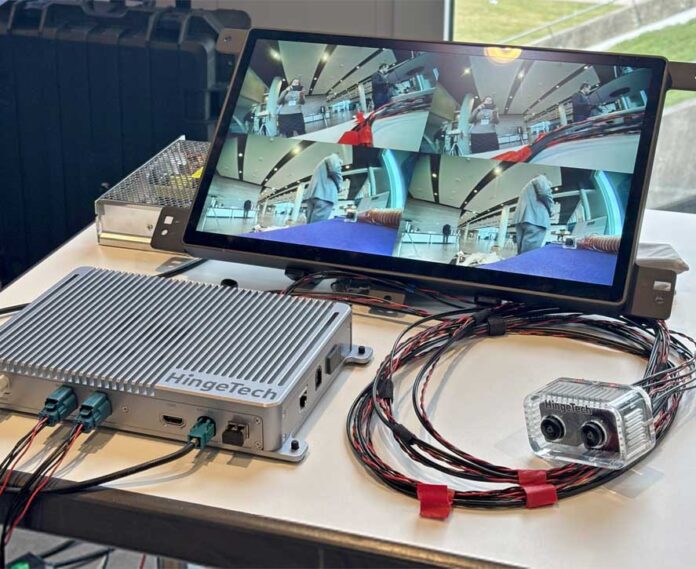
Yang Jun, CTO of Hinge Technology, highlighted the system during a live demonstration at the Automotive Ethernet Congress in Munich. The showcase featured 10 Gb/s optical links powered by KD’s KD7251, demonstrating lossless transmission of high-resolution video streams and real-time data exchange across a fiber-optic network.
By combining multiple 10 Gb/s camera inputs and directly comparing them with traditional 1 Gb/s links, the demonstration revealed significant improvements in image quality, latency, and overall system performance. According to Hinge Technology, the results confirm the readiness of optical multigigabit connectivity for deployment in future automotive applications.
Commenting on the collaboration, Pablo Blázquez, Business Development Manager for Europe at KD, said the integration demonstrates the scalability and future-readiness of Hinge Technology’s optical architecture. The solution supports both 1 Gb/s and 10 Gb/s camera connectivity while aggregating video streams through a 10 Gb/s optical backbone powered by the KD7251.
Beyond automotive applications, KD believes the platform could also address growing demand in sectors such as robotics, where reliable, high-bandwidth connectivity is increasingly critical. The collaboration highlights the expanding role of optical networking technologies in enabling advanced vehicle electronics and data-intensive mobility systems.
Multi-camera Architecture with 10 Gb/s Optical Data Transmission
The demonstrated system is based on a multi-camera architecture with optical links throughout the vehicle network. Two 10 Gb/s optical cameras are connected to each of two electronic control units (ECUs), with data transmitted over a fiber-optic backbone between the ECUs. One ECU aggregates and processes a total of four high-resolution video streams for functions such as image stitching and display output. In addition, a 1 Gb/s optical camera link is integrated for direct comparison between gigabit and multigigabit transmission.
KD7251 Enables Multigigabit Optical Links for In-vehicle Networks
At the core of the system, the KD7251 is a single-chip optoelectronic transceiver with an integrated optical interface, combining optical and electronic functionality in a compact device. It enables multigigabit data transmission over multimode glass optical fiber (OM3), supporting data rates up to 10 Gb/s as well as backward-compatible operation at lower speeds for flexible integration of different camera and sensor types. With low latency, robust EMC performance, and support for automotive requirements such as ASIL-B functional safety and extended temperature ranges, the KD7251 is designed for reliable high-speed connectivity in demanding in-vehicle environments. Its integrated bridging capabilities further support direct connection of camera sensors and processing units.