Toyota Motor Europe (TME) has expanded its hydrogen mobility strategy at IAA Transportation 2026, announcing partnerships with Scania and IVECO to deploy its third-generation fuel cell technology in heavy-duty commercial vehicles.
Alongside the vehicle partnerships, Toyota is also working to strengthen hydrogen infrastructure and develop the broader ecosystem required for wider adoption of fuel cell mobility.
Hydrogen remains an important part of Toyota’s multi-pathway approach to carbon neutrality, particularly for commercial applications where long driving ranges, high vehicle utilisation, rapid refuelling, payload capacity and operational flexibility are critical.
Toyota’s Third-Generation Fuel Cell Technology
Toyota said its third-generation fuel cell system has been developed specifically for commercial vehicle applications. Compared with the previous generation, the new system offers twice the output and durability, along with a 20% improvement in fuel efficiency and significantly reduced costs.
The technology will initially be deployed through partnerships with Scania and IVECO, allowing Toyota to gather real-world operating data and further validate the technology under demanding heavy-duty conditions.
Toyota to Supply Fuel Cells for Scania Trucks
Toyota will supply its third-generation fuel cell systems to Scania for 40 heavy-duty trucks under the Swedish manufacturer’s Pilot Partner programme.
The trucks will be equipped with Toyota’s latest 300kW fuel cell system in a compact configuration developed for heavy-duty applications. The first vehicles are expected to enter real-world operation during the first quarter of 2027.
The pilot programme will generate operational data covering fuel cell performance, efficiency and total cost of ownership under long-distance and high-utilisation conditions.
The findings are expected to provide further insight into the suitability of hydrogen fuel cell technology for demanding commercial transport applications.
IVECO Fuel Cell Truck Targets More Than 900km Range
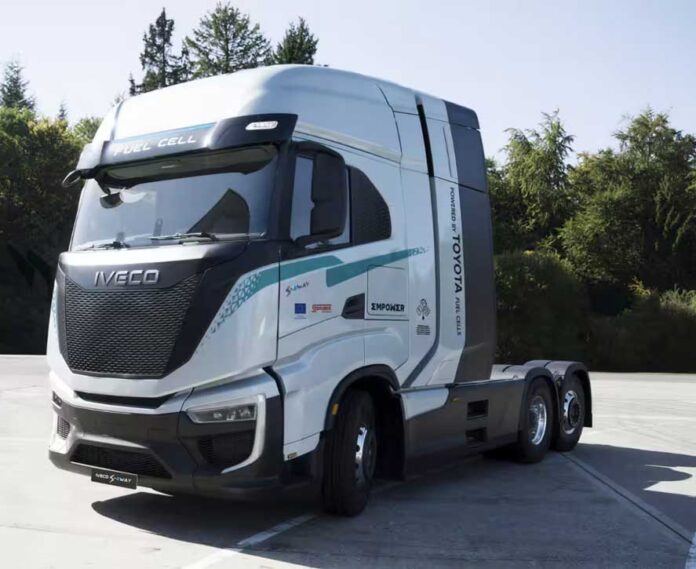
Toyota is also partnering with IVECO through EMPOWER, an EU-funded Horizon Europe project focused on zero-emission heavy-duty transportation.
Under the partnership, Toyota will supply fuel cell systems for IVECO’s next-generation fuel cell electric vehicles, while IVECO will be responsible for vehicle development, system integration and validation.
The IVECO S-eWay Fuel Cell will use Toyota fuel cell systems delivering a combined output of 300kW. The truck is being developed with a targeted driving range of more than 900km and durability exceeding 25,000 operating hours.
Validation is scheduled to begin in the fourth quarter of 2026, followed by on-road testing during the first half of 2027.
Toyota Strengthens Fuel Cell Technology Partnership
Toyota’s latest collaborations come after a binding agreement signed in July between Volvo Group, Daimler Truck AG, cellcentric and Toyota Motor Corporation.
Under the agreement, Toyota will join cellcentric as an equal partner and shareholder, subject to regulatory approval. The companies aim to strengthen cellcentric’s position in the development and manufacturing of fuel cell systems for heavy-duty commercial vehicles.
The partnership is expected to support the scaling of fuel cell technology for the commercial vehicle sector and strengthen cooperation between major players across the hydrogen mobility value chain.
Hydrogen Infrastructure Key to Wider Adoption
Toyota believes that advancing fuel cell vehicle technology alone will not be sufficient to accelerate hydrogen mobility. The availability of hydrogen supply, refuelling infrastructure, customer demand and supportive policy frameworks will all need to develop alongside vehicle deployment.
The company highlighted Germany and the Netherlands as examples where vehicle deployment and hydrogen refuelling infrastructure are being developed in parallel, supported by regulatory frameworks such as the Alternative Fuels Infrastructure Regulation.
Shinichi Yasui, Executive Vice President, R&D, Toyota Motor Europe, said: “Hydrogen can play an important role in sustainable mobility where energy resilience and demanding operational needs are critical.”
He added: “Toyota is not only developing fuel cell technology and vehicles, we are also committed to supporting the infrastructure needed to fuel them. By advancing our fuel cell technology and working with partners across the value chain, Toyota aims to help build the ecosystems needed to bring hydrogen mobility closer to wider deployment.”
Toyota Hilux Fuel Cell Planned for 2028
Toyota is also preparing to expand its fuel cell portfolio beyond heavy-duty trucks. The company plans to launch the Hilux Fuel Cell in 2028.
The hydrogen-powered pickup is targeting a driving range of more than 400km and a towing capacity of up to 2.5 tonnes.
With partnerships across the commercial vehicle industry and continued investment in fuel cell technology and infrastructure, Toyota is positioning hydrogen as a potential zero-emission solution for applications where battery-electric powertrains may face limitations related to range, payload, utilisation and refuelling time.