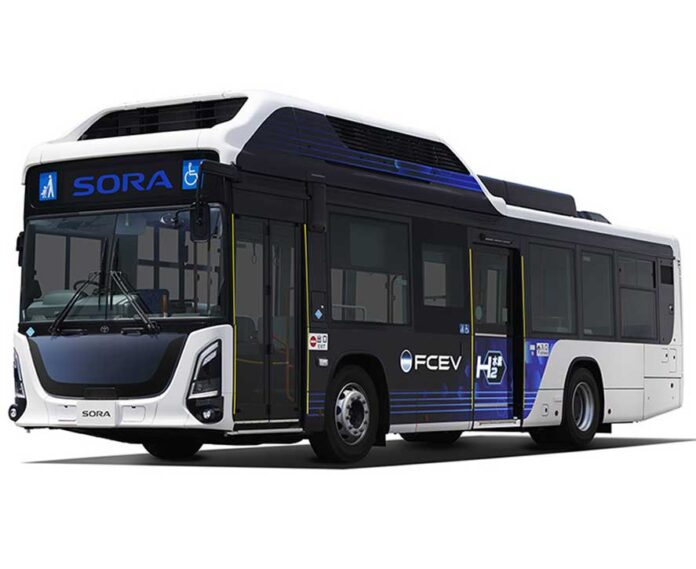
Toyota Motor Corporation has launched the new-generation ‘Sora’ fuel cell route bus, powered by hydrogen, as part of its efforts to promote hydrogen mobility and support the transition towards a carbon-neutral society.
Toyota considers hydrogen an important energy source for achieving carbon neutrality. The company introduced its first fuel cell electric vehicle (FCEV), the Mirai, in 2014 and has since sold it in more than 30 countries and regions. Since 2019, Toyota has also been supplying fuel cell systems (FC systems) that generate electricity using hydrogen. By the end of September 2026, the company had supplied more than 3,500 FC systems to over 100 customers worldwide for applications including buses, railways and stationary power generators.
In 2018, Toyota introduced the first-generation Sora, bringing clean and quiet fuel cell technology to public transportation. The new-generation model builds on this foundation with improvements in driving range, safety and operational convenience.
The new Sora is a next-generation fuel cell route bus jointly developed by Isuzu Motors Limited and Toyota. The vehicle combines Isuzu’s battery electric vehicle (BEV) full-flat route bus platform with Toyota’s fuel cell system, bringing together their respective technologies to improve the environmental performance and usability of public transport buses.
Key Features and Upgrades
Improved Fuel Cell System and Driving Range
The new Sora features an upgraded fuel cell system designed to improve energy efficiency by optimising the use of its fuel cell and large-capacity battery. Compared with the first-generation model, the total hydrogen tank capacity has been reduced by approximately 20%, while the driving range has increased by around 100 km to more than 300 km.
Toyota has incorporated a compact fuel cell stack developed specifically for commercial vehicles, offering higher output and improved durability. The company has also developed a new high-capacity hydrogen tank for commercial applications.
The fuel cell system is compactly integrated into the roof, making maintenance and servicing easier for bus operators.
Enhanced Safety Features
The new Sora comes equipped with several safety technologies aimed at improving driver assistance and passenger protection.
One of the key additions is the Emergency Driver Stop System (EDSS), which works in conjunction with the Driver Status Monitor (DSM). If the system detects an issue with the driver’s condition, it automatically decelerates the bus and brings it to a stop. Once stationary, the parking brake is applied automatically, helping maintain vehicle stability even on slopes.
The bus also features a front blind spot monitoring system that detects pedestrians and bicycles ahead of the vehicle and alerts the driver, helping reduce the risk of accidents.
Improved Passenger Accessibility and Operational Convenience
Toyota has adopted a full-flat, step-free floor design to improve accessibility within the passenger compartment. The layout allows passengers, including wheelchair users and people travelling with strollers, to move around more easily and safely.
An optional one-touch wheelchair securement system will also be offered from around April 2027. The system is designed to simplify wheelchair boarding and securement, reducing the effort required from drivers.
The new Sora will be available in four variants, comprising two urban and two suburban configurations, with different seating arrangements to meet varying public transport requirements.
For operational convenience, the bus can be refuelled with hydrogen in approximately 10 minutes. It also complies with a new high-speed hydrogen filling standard, which could reduce refuelling time by around half when compatible hydrogen stations become available in the future.
Additionally, the vehicle can function as an emergency power source during disasters when connected to an external power supply unit.
Toyota’s Continued Focus on Hydrogen Mobility
Toyota has been working with various partners across the hydrogen value chain, including production, transportation, storage and utilisation. The company plans to continue supporting the adoption of hydrogen-powered mobility through collaborations with government agencies and businesses.
These initiatives include participation in the hydrogen backbone network implementation initiative, a joint public-private effort aimed at expanding hydrogen infrastructure and encouraging wider hydrogen adoption.
Toyota Sora: Key Specifications (Urban Model)
| Specification | Details |
| Overall length | 10,545 mm |
| Overall width | 2,485 mm |
| Overall height | 3,440 mm |
| Passenger capacity | 70 persons (19 seated + 50 standing + 1 crew) |
| Fuel Cell Stack | |
| Type | Toyota FC Stack (Polymer Electrolyte Membrane) |
| Maximum output | 113 kW |
| Motor | |
| Type | AC Induction Motor |
| Maximum output | 220 kW (110 kW × 2) |
| Maximum torque | 970 Nm (485 Nm × 2) |
| High-Pressure Hydrogen Tanks | |
| Number and nominal pressure | 3 tanks (70 MPa) |
| Total tank volume | 471 litres |
| Propulsion Battery | |
| Type | Lithium-ion battery |
With the upgraded Sora, Toyota aims to strengthen the role of hydrogen-powered vehicles in public transportation. The combination of an extended driving range, improved safety systems, accessible passenger space and shorter refuelling times is designed to address the operational requirements of route bus services while supporting the wider adoption of zero-emission mobility.