
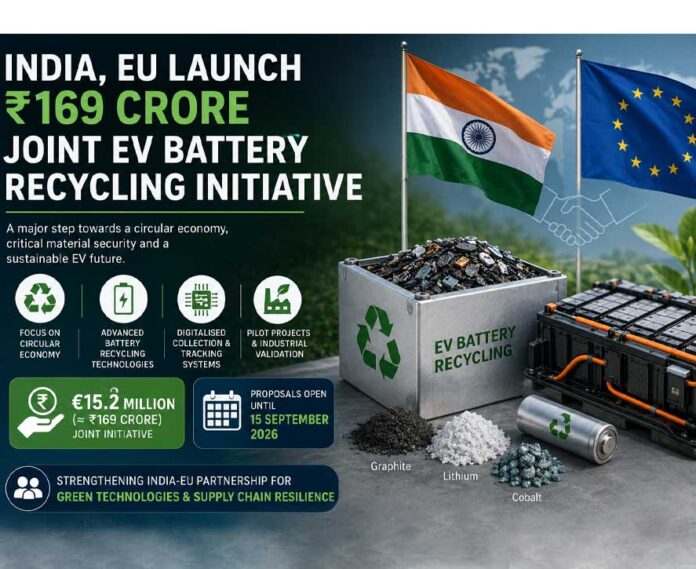
India and the European Union have launched a joint €15.2 million (approximately ₹169 crore) initiative focused on electric vehicle (EV) battery recycling under the India-EU Trade and Technology Council (TTC) Working Group 2 on green and clean energy technologies.
The programme marks the third coordinated call for proposals between India and the EU, with applications open until September 15, 2026.
Focus on Circular Economy and Critical Materials
The initiative aims to strengthen access to critical raw materials, accelerate the transition toward a circular economy, and deepen collaboration between India and the European Union in sustainable mobility technologies.
Funding for the programme will be provided through Horizon Europe, while the Ministry of Heavy Industries will support the Indian side of the initiative.
The collaboration will focus on developing advanced battery recycling technologies, including:
- High-efficiency material recovery systems
- Digitalised battery collection and tracking systems
- Pilot-scale recycling demonstration projects
- Industrial validation through a joint India-EU pilot line in India
The programme will also address key areas such as:
- Higher recovery rates for critical materials
- Recycling of mixed battery chemistries
- Integrated logistics systems
- Safety standards for second-life battery applications
Critical materials targeted under the initiative include lithium, graphite, cobalt, and other strategically important battery minerals.
Supporting India’s Growing EV Ecosystem
Ajay Kumar Sood, Principal Scientific Adviser to the Government of India, described the initiative as an important step toward strengthening India-EU cooperation in clean technology and resource security.
He noted that as India’s electric vehicle market continues to expand rapidly, building a domestic battery recycling ecosystem will become increasingly important for resource sustainability and environmental goals.
Hervé Delphin, Ambassador of the European Union to India, highlighted the strategic role of batteries in the global green transition and said the initiative aims to move innovations from research into large-scale deployment while strengthening mineral security.
Building a Digital and Inclusive Recycling Ecosystem
Parvinder Maini, Scientific Secretary at the Office of the Principal Scientific Adviser, said the programme is designed to support the development of a digital, efficient, and inclusive battery recycling ecosystem.
He added that the initiative also aims to integrate India’s informal recycling sector into a more organised and sustainable framework.
Marc Lemaître, Director-General for Research and Innovation at the European Commission, stated that the collaboration will help establish a cross-continental value chain for critical raw materials and battery recycling technologies.
Strengthening India-EU Green Technology Cooperation
The initiative reflects growing strategic cooperation between India and the European Union in green technologies, clean mobility, and resilient supply chains.
As electric vehicle adoption accelerates globally, battery recycling and critical mineral recovery are becoming increasingly important for reducing import dependence, supporting sustainability goals, and strengthening long-term EV ecosystem resilience.