Investment in R&D by lithium-ion battery equipment manufacturers remains closely linked to overall market conditions, with the sector witnessing sharp fluctuations in recent years. At the same time, a clear divergence has emerged between the R&D strategies of Chinese and South Korean companies. In its latest insight, market intelligence firm Interact Analysis, through analyst Shirly Zhu, examines the evolving trends shaping the lithium-ion battery equipment R&D landscape.
The study analyses R&D investment and activities across 16 vendors whose core business focuses on lithium-ion battery equipment, selected from the world’s top 25 suppliers in the segment. It offers an in-depth look at how changing market dynamics are influencing innovation strategies.
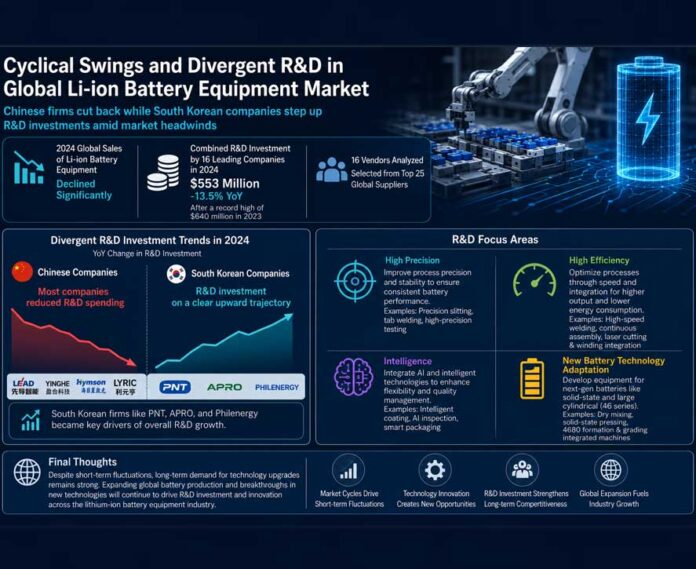
In 2024, global sales of lithium-ion battery equipment declined significantly, with Chinese equipment makers facing particularly steep revenue contractions. This slowdown had a direct impact on innovation spending, as combined R&D investment by the 16 leading companies dropped 13.5% year-on-year after reaching a record high of $640 million in 2023. The total R&D figure also includes spending related to non-lithium-ion battery equipment businesses.
A notable contrast emerged between Chinese and South Korean firms during the year. Most Chinese vendors reduced their R&D budgets amid weakening demand and declining revenues. In contrast, South Korean companies such as PNT, APRO, and Philenergy increased their R&D spending, maintaining a strong upward trajectory and becoming key contributors to overall growth in sector-wide innovation investment.
Chinese vendors lead in investment intensity, South Korean companies shine in growth
R&D investment in the global lithium-ion battery equipment industry is clearly concentrated among the top players. The ranking of companies’ R&D spending lines up with their sales performance, showing an investment logic of ‘spending within one’s means.’
As the world’s top two lithium-ion battery equipment firms, China-based Lead Intelligent and Yinghe Technology also take the top two spots in R&D investment. Lead Intelligent stands out with a particularly strong R&D edge. Its annual R&D spending has exceeded $200 million for three years in a row, far outpacing other companies. Hymson ranks third with steady R&D input.
Further, Chinese Li-ion battery equipment makers have much higher R&D intensity (R&D spending as a percentage of revenue) than their South Korean counterparts. During 2022 to 2024, the top six companies by R&D spending were all from China. Even amid the 2024 industry downturn, Lead Intelligent, Lyric Robot, and Hymson kept their R&D ratios above 10%; well above the median levels of 6.1%, 4.7%, and 4.3% from 2022 to 2024. In contrast, South Korean enterprise PNT ranked third in global sales in 2024, but only seventh in R&D investment. Other South Korean enterprises entering the top 25 in global sales have R&D investment rankings significantly lagging behind their sales rankings.
Chinese lithium-ion battery equipment makers’ strategy of investing a large share of their revenue in R&D is a diversified choice that balances market adaptation with industry expansion.
On one hand, they focus on key areas like high-precision processes, constantly upgrading equipment performance and operational stability. This lets them closely match the evolving needs of China’s lithium-ion battery industry, specifically for higher efficiency, greater energy density, and better safety, to ensure their equipment keeps pace with downstream production upgrades.
On the other hand, they leverage the automated and intelligent tech expertise built up in the lithium-ion battery equipment space to expand into new areas like new energy and industrial automation. This not only broadens their business scope but also spreads the risks of relying on a single industry, boosting their overall competitiveness.
When it comes to the resilience of R&D investment growth, there’s a clear gap between Chinese and South Korean equipment firms. Of the 16 core companies, 10 maintained positive compound annual growth (CAGR) in R&D spending from 2022 to 2024, with South Korean enterprises standing out with particularly strong growth. Six out of seven South Korean firms achieved steady R&D investment growth, with rates well above the industry average. In contrast, Chinese enterprises were hit hard by the 2024 market slump, and R&D spending for five key Chinese firms dropped below 2022 levels.
R&D focuses on high precision, high efficiency, intelligence, and new battery technology adaptation
In terms of R&D activities, lithium-ion battery equipment enterprises’ R&D focuses on improving the large-scale production of existing lithium-ion batteries and deploying next-generation battery technologies, which can be roughly summarized as moving in the following four core directions:
- High precision: Improving the processing precision and process stability of equipment in various process links to ensure the consistency of battery performance. Examples include precision slitting, tab precision welding, and high-precision testing.
- High efficiency: Optimizing the manufacturing process through equipment speed-up and process integration for higher production efficiency and reduced energy consumption. Examples include high-speed welding, high-speed winding/stacking, film wrapping and casing, continuous cell assembly, and laser cutting and winding integrated machines.
- Intelligence: Deeply integrating intelligent technologies into equipment in various process links to continuously improve production flexibility and quality management. Examples include intelligent coating systems, intelligent cell casing and packaging, and AI-based appearance inspection equipment.
- New battery technology adaptation: Developing adaptive equipment for the manufacturing processes of new batteries, such as solid-state batteries and large cylindrical batteries (46 series). Examples include dry mixing equipment, sulfide solid-state dry electrolyte membrane equipment, solid-state battery isostatic pressing equipment, and 4680 formation and grading integrated machines.
R&D investment in the lithium-ion battery equipment sector may fluctuate with market cycles in the short term, but long-term demand for technological advancement remains strong. As EV batteries, energy storage systems, and next-generation technologies such as solid-state batteries continue to evolve, equipment makers will need to improve process adaptability, precision, and intelligent manufacturing capabilities.
The global lithium-ion battery equipment market, led by Chinese and South Korean companies, is being reshaped by expanding battery production capacity worldwide and rapid technological breakthroughs. These trends are creating opportunities for both established players and emerging companies to strengthen their market positions.
As a result, companies across the industry are expected to continue increasing R&D investments, focusing on core technologies and next-generation manufacturing processes to drive innovation and support the long-term growth of the global lithium-ion battery industry.