
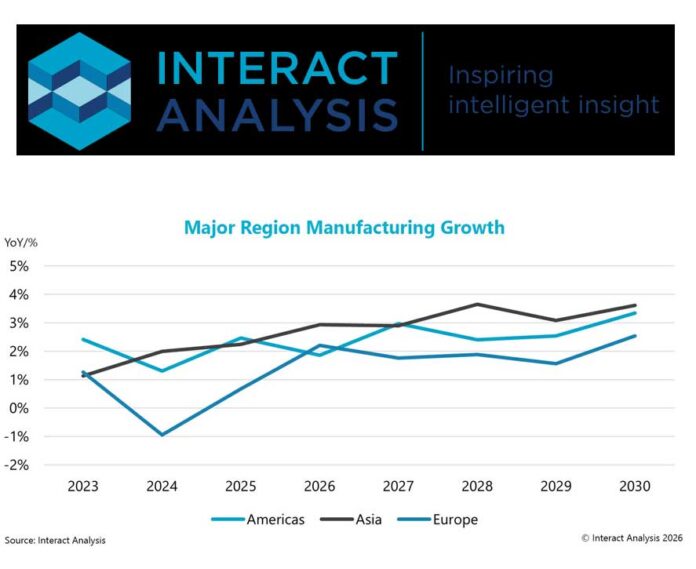
The global manufacturing sector is expected to grow at a slower pace in 2026 than previously anticipated, according to the latest Manufacturing Industry Output (MIO) Tracker released by Interact Analysis. The market intelligence firm has revised its 2026 global manufacturing output growth forecast downward from 2.9% to 2.6%, citing escalating geopolitical tensions, rising energy costs, and ongoing trade-related uncertainties.
The downgrade reflects the impact of the recent US-Israel conflict involving Iran, which has disrupted global energy markets and heightened concerns over the strategic Strait of Hormuz shipping route. Combined with continued tariff actions by the United States, these developments have increased input costs for manufacturers and prompted a more cautious approach to capital investment across industries.
Interact Analysis has also lowered its average annual manufacturing growth forecast for the 2025–2030 period from 3.1% to 2.9%, indicating that geopolitical instability is likely to remain a key challenge for global industrial growth in the coming years.
Despite the downward revision, the outlook remains positive overall, with all of the world’s top 10 manufacturing economies still expected to record growth in 2026. The report suggests that while geopolitical disruptions continue to create uncertainty, manufacturers are increasingly adapting their supply chains and operations to improve resilience and mitigate risk.
Regionally, Asia is projected to remain the strongest-performing manufacturing hub, with output growth forecast at 2.9% in 2026, although this is lower than the previous estimate of 3.2%. The region is also expected to deliver the highest cumulative growth among major manufacturing regions between 2025 and 2030.
In contrast, the Americas are expected to experience the slowest manufacturing growth, with the 2026 forecast revised down to 1.9% from 2.2%. The weaker outlook reflects ongoing economic uncertainty, elevated costs, and the impact of trade and geopolitical developments on industrial activity.
According to Interact Analysis, the latest forecasts highlight how geopolitical tensions and supply chain disruptions are increasingly becoming a permanent feature of the global manufacturing landscape. However, the sector’s continued ability to adapt and strengthen operational resilience is expected to support moderate growth despite a challenging external environment.
Global disruptions are increasingly becoming the status-quo
Interact Analysis has found that businesses are increasingly viewing frequent global shocks as the new status quo, with many choosing to adapt their supply chains to become more resilient to a new culture of uncertainty and disruption. Just-in-time (JIT) manufacturing processes have become unpopular due to their lack of flexibility in the face of sudden disruption, and many firms are also beginning to account for potential energy price shocks in an effort to mitigate the effects of any future disruptions. Because of these efforts from the manufacturing industry to strengthen their supply chains and hedge for uncertainty, Interact Analysis predicts the overall effect on production from the current oil shock will be a small pullback. However, analysts warn that, should this disruption persist, rising input costs and weaker consumer demand could feed more directly into sector-level production declines. This could result in a significant downgrade from the current outlook.
Semiconductor production remains strong, despite challenges
While growth forecasts for 2026 and the 2025-30 period have been downgraded due to geopolitical factors, a number of sectors have continued to resist the negative effects of these disruptions. Interact Analysis projects the semiconductor sector will experience strong growth across the global manufacturing economy, appearing in the top performing sectors for 8 of the 10 largest manufacturing economies. The United States leads the way with the strongest projected growth rate of 10.7% in its semiconductor sector during 2026, while South Korea is a close second with a projected growth rate of 10.3%.
The strong growth rate in the United States comes in part from AI-driven demand for data centers, as well as the 2022 CHIPS & Science Act, which provides funding for domestic semiconductor research and manufacturing. In South Korea, the growth in the semiconductor sector can be explained by heavy global demand for high-end chips manufactured in the country, leading to high export volumes.
Jack Loughney, Interact Analysis Senior Data Analyst, UK, says, “Overall business sentiment from our clients is that, notwithstanding the current events across the globe which are somewhat concerning, they have begun to inoculate themselves against uncertainty. Just-in-time manufacturing is mostly a thing of the past, energy price shocks have been accounted for, and many companies see being disrupted as the status quo instead of an exceptional event.
“The longer-term implications of the current Middle East conflict and disruption to the Strait of Hormuz remain highly uncertain and will depend on how the situation develops over the coming months. In the short term, we can expect a reduction in consumer spending due to higher essential costs. However, the effect on overall production is expected to be a small pullback rather than a severe black swan event.”