
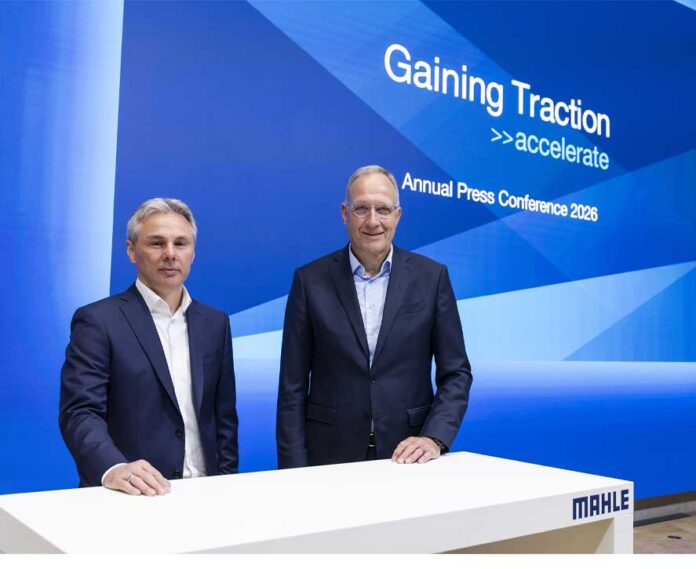
MAHLE reported improved operational profitability for the 2025 financial year, navigating a challenging environment marked by economic uncertainty, new U.S. tariffs, supply chain disruptions, and ongoing regulatory developments. The technology group recorded revenue of €11.3 billion, with organic growth of 0.6 percent after adjusting for exchange rate and deconsolidation effects.
Adjusted earnings before interest and taxes (EBIT) rose to €442 million, while the adjusted EBIT margin improved to 3.9 percent, reflecting stronger operational performance. The company also reduced its net debt and improved its equity ratio, achieving a positive net income for the year and reinforcing the operational turnaround initiated in 2023 and sustained through 2024.
MAHLE attributed the improved results to synergies created through its new group structure and stronger regional operations, which have helped accelerate decision-making and operational efficiency. The company’s MAHLE 2030+ strategy, focusing on electrification, thermal management, and continued leadership in internal combustion engine technologies, continues to drive progress.
Innovation remained a key priority, with MAHLE maintaining its R&D investment at 5.4 percent of revenue and generating around 860 patents and invention reports during the year, underscoring the group’s ongoing commitment to technology development.
“MAHLE is on the way to profitable growth,” said Arnd Franz, Chairman of the Group Management Board and CEO, during the company’s annual press conference in Stuttgart. He added that the company will continue to adapt to volatile market conditions while advancing its ‘Back on Track’ efficiency programme to strengthen competitiveness and operational resilience.
MAHLE 2025: Market Challenges, Strategic Adjustments and Growth Diversification
MAHLE faced another challenging business year in 2025 amid geopolitical uncertainties, rising energy costs, currency fluctuations, and slowing automotive markets across several regions. Intense competition, particularly from China, further pressured the business environment. In response, the company accelerated its efficiency programme, streamlined its organizational structure, optimized its product portfolio, and consolidated its production network. Capacity adjustments were also implemented, particularly in Europe and North America, to align with reduced demand.
Sales Impacted by Weak Demand and Currency Effects
Declining vehicle production in Europe and North America weighed on MAHLE’s sales performance. The sluggish truck market in the United States and slower-than-expected electrification in Europe also affected demand. Currency depreciation against the euro and portfolio adjustments, including the sale of joint venture stakes and business divisions, further impacted revenue.
Among business segments, the Powertrain and Charging unit reported €3.9 billion in sales, growing 1.9 percent on a currency-adjusted basis despite slow EV adoption in Europe. The Thermal and Fluid Systems division generated €6.1 billion, maintaining stable performance year-on-year. Meanwhile, the Lifecycle and Mobility business, covering spare parts and services, recorded €1.2 billion in revenue and achieved 1.7 percent growth after currency adjustments.
Regional Performance: India Emerges as Fastest-Growing Market
While sales declined in Europe and China, MAHLE recorded growth in North America, South America and East Asia. India emerged as the fastest-growing market, delivering more than 20 percent growth on a currency-adjusted basis. Despite market challenges, all regions managed to improve or stabilize profitability levels.
Improved Profitability and Stronger Financial Position
MAHLE improved operating profit through productivity gains, cost optimization, and pricing adjustments, which helped offset tariff costs, inflation, raw material price increases, and lower volumes. The company reduced net debt by €136 million to €1.03 billion and improved its equity ratio to 21.9 percent, strengthening its financial position.
The company also secured financial flexibility with the extension of a €1.2 billion syndicated loan until February 2029, reflecting strong confidence from financial institutions in MAHLE’s long-term strategy.
Innovation Focus: Electrification and Thermal Management
MAHLE invested €607 million in R&D, with around 4,500 engineers working on climate-friendly mobility solutions. The company filed 361 patents and 497 invention reports, with approximately 70 percent focused on electrification. Key innovations included a range extender system, thermal management module with heat pump, and bionic radial blower for EVs.
The company also expanded beyond automotive applications, developing cooling systems for battery storage, data centers, and megawatt charging infrastructure, along with diagnostic tools and high-voltage electronics for EV workshops.
Order Intake Stable but Electrification Slower Than Expected
MAHLE secured new orders representing €1.9 billion in annual sales, with strong demand for power electronics, electric drive systems, thermal systems, and internal combustion engine components. However, electrification-related orders fell short of expectations due to slower EV adoption, especially in Europe, competitive pressure, and changing policy environments.
Diversification Beyond Automotive
To reduce risk, MAHLE expanded into non-automotive sectors such as maritime, mining, rail, logistics, defense, and stationary infrastructure. The company also created a new Industrial and Special Solutions unit to develop new business opportunities, including data center cooling, megawatt charging, chip cooling, and power electronics.
Workforce Adjustments and Consolidation
Due to market pressures, MAHLE continued restructuring efforts, including plant closures, divestments, and workforce reductions, primarily in Europe and North America. The company’s global workforce declined to 64,242 employees, down 5.1 percent year-on-year. MAHLE also continues cost reductions in administration and development.
Policy Concerns and Future Outlook
MAHLE highlighted ongoing consolidation pressure in Europe, particularly due to CO₂ regulations. CEO Arnd Franz urged policymakers in Stuttgart, Berlin, and Brussels to support technological diversity and growth-friendly policies, warning that restrictive regulations could lead to investment and job losses in Europe.
Key Financial Highlights 2025
- Sales: €11.26 billion (2024: €11.68 billion)
- Adjusted EBIT: €442 million (up from €347 million)
- Adjusted EBIT Margin: 3.9 percent (up from 3.0 percent)
- Net Profit: €20 million
- Equity Ratio: 21.9 percent (up from 20.1 percent)
- Net Debt: €1.03 billion (reduced by €136 million)
- Workforce: 64,242 employees (down 5.1 percent)
Despite market headwinds, MAHLE strengthened profitability, improved financial stability, and accelerated diversification efforts, positioning the company for long-term growth across both automotive and non-automotive sectors.