
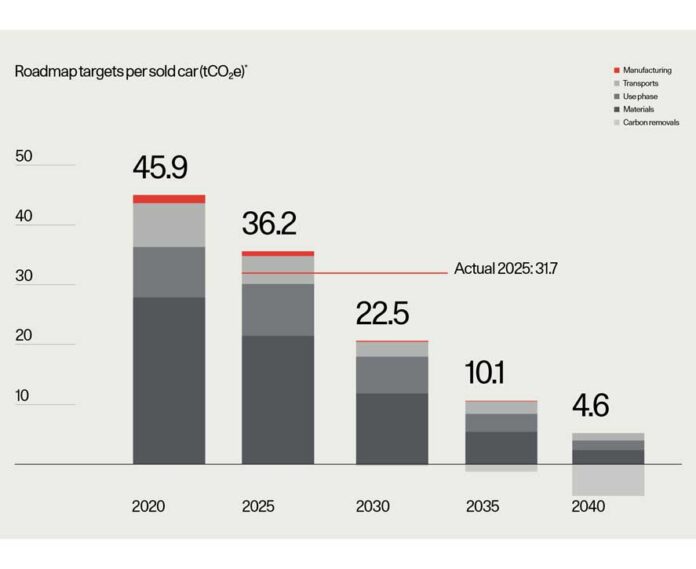
Polestar has reported a 31% reduction in greenhouse gas (GHG) emissions per vehicle sold since 2020, according to its 2025 Sustainability Report.
Over the same period, the company significantly expanded its global footprint, with annual retail sales surpassing 60,000 units and operations extending across 28 markets. Polestar also introduced three new models and established manufacturing facilities in three countries.
At a time when parts of the automotive industry face challenges in meeting climate commitments, the EV maker continues to demonstrate measurable progress by aligning business growth with reduced environmental impact, reinforcing its position as a leader in sustainable mobility.
The reduction in emissions per sold car since 2020 reflects the Company’s focus on increasing renewable energy use related to battery production and manufacturing, and use of low-carbon materials. Over the past year, increased volumes of Polestar 4, the company’s lowest carbon footprint car to date, has also been a significant factor, alongside the expansion of renewable energy across key European markets, which drives down use-phase emissions. Europe remains Polestar’s largest market, representing over 75% of sales. Polestar continues to stay below its emissions reduction curve, heading towards its goal of becoming a climate-neutral company by 2040.
Michael Lohscheller, Polestar CEO, says: “If you are not reducing emissions while growing, you are choosing not to. Electrification delivers clear value for customers: lower running costs, lower emissions and greater peace of mind, as volatile oil prices and fuel scarcity mean pump anxiety is increasingly replacing range anxiety. As clean electricity scales, electric vehicles are becoming not just the sustainable choice, but the smarter, more reliable one.”
At a societal level, electrification offers a clear path to reducing lifecycle GHG emissions from passenger transport, as renewable energy and EV adoption scale together. As electricity becomes cleaner and more stable than petroleum-based fuels, the role of electric vehicles as a climate solution is becoming even more evident.
Recent results from the Polestar 0 project
Work at the Mission 0 House in Gothenburg brings together industry and academia to eliminate emissions from high‑impact materials, products, and processes. This research is driving new materials, technologies, and partnerships toward the Polestar 0 project goal of a net‑zero car without offsets by 2035. The initial 2030 timeline has been revised, reflecting the scale and complexity of the challenge, but also the opportunity. On the contrary of giving up, Polestar consolidates the task through the dedicated research in the Mission 0 House.
Fredrika Klarén, Head of Sustainability at Polestar, says: “The Polestar 0 project pushes us into new territory. While much of the industry invests in hybrids and combustion engines, we focus on solutions that eliminate emissions entirely. The innovation emerging from this project shows the power of collaboration and material science, and importantly, how well positioned we are to move the industry forward.”
Key developments from Mission 0 House include:
- Large‑scale pilot for ultra‑low‑emission steel
- Research on materials for batteries
- Development of bio‑based textile alternatives
- Technologies converting CO₂ into new materials
Mission 0 House was formally established in 2025, securing close to SEK 100 million in funding over five years towards the research consortium. The current collaboration includes five Swedish higher education institutions and six companies.