Schaeffler is set to showcase its latest innovations in electrified powertrains at the 13th Schaeffler Automotive Symposium, scheduled to take place in Bühl this June. The motion technology company will present a comprehensive range of solutions designed for battery electric vehicles (BEVs), hybrid systems including plug-in hybrids (PHEVs) and conventional hybrids (HEVs), as well as range extender electric vehicles (REEVs).
As electric mobility becomes increasingly embedded in the automotive landscape, Schaeffler continues to play a key role in driving the transition toward sustainable transportation. Leveraging its extensive expertise, the company positions itself as a strategic partner to automakers, offering tailored powertrain solutions that align with varying customer needs and market demands.
With its broad and innovative portfolio, Schaeffler aims to support the evolving mobility ecosystem by delivering adaptable and future-ready electrification technologies.
“With our Powertrain technology cluster, we will be showcasing Schaeffler’s extensive development capabilities in the powertrain segment at the Schaeffler Automotive Symposium. We offer all customers the entire spectrum of powertrain technologies – from components to functionally integrated systems,” says Matthias Zink, CEO Powertrain & Chassis at Schaeffler AG.
BEV: highly integrated solutions for the electrical powertrain
In the battery electric vehicle segment, Schaeffler is systematically driving the development of highly integrated electric drive systems. The company is focusing on e-axles, electric drive units, transmission components, bearing solutions, and electronic and software-based solutions that can be combined to deliver highly efficient overall systems.
“Our expertise in mechanical engineering, electronics and software enables us to develop scalable system solutions. Thanks to a consistently integrated approach, Schaeffler is developing electric powertrains that optimally combine efficiency, a compact footprint, functionality, sustainability and industrialization,” says Thomas Stierle, CEO E‑Mobility at Schaeffler AG.
In competition, Schaeffler focuses on a high degree of integration, compact design, and a streamlined development. “With our new development approach, we are reducing the complexity of our products – in the case of e-axle systems, for example – and in collaboration with our customers are bringing our products to market readiness sooner,” says Stierle. “Our BEV solutions are efficient and compact, and can be scaled to meet specific customer requirements. In this context, system and functional integration are the key to success.”
Among other things, Schaeffler demonstrates its system expertise with innovative inverter solutions: Integrated, scalable inverter platforms with X-in-1 functionality and flexible manufacturing concepts allow for faster time-to-market and lower system costs, for example.
In the case of electric motors, Schaeffler is also increasing value creation through greater material efficiency, modern manufacturing technologies, and targeted design optimizations. The company’s product portfolio is complemented by decades of transmission expertise and components like bearings – e.g., current-insulated bearings – for efficient, compact and scalable applications.
HEV: system solutions for hybrid drive systems and range extenders
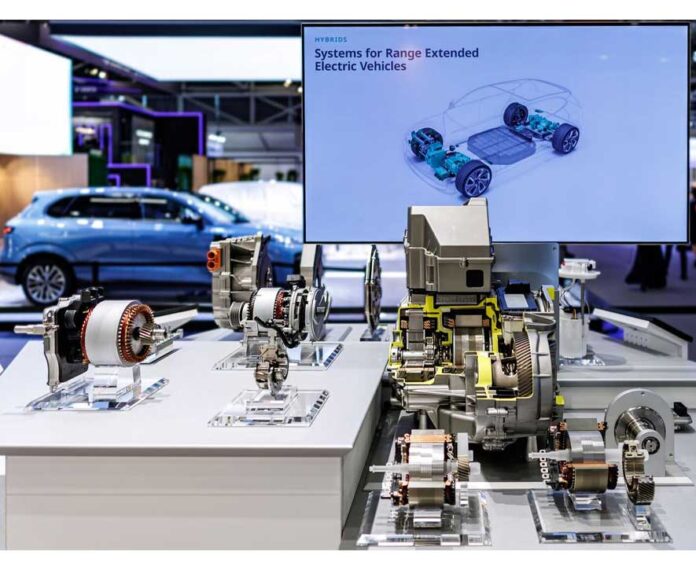
In the second key area of the Powertrain technology cluster, Schaeffler will present its system solutions for hybrid topologies and range extender applications. “Hybrid solutions and range extenders are key elements of the ongoing mobility transition. With our integrated approach to the hybrid powertrain, we have a broad and innovative product range that combines proven and new technologies to meet requirements for efficiency and sustainability. In this way, we help our customers to implement a wide range of powertrain architectures,” states Matthias Zink.
Schaeffler offers an extensive range for various hybrid topologies – from P1 to P3 systems and beyond. The focus is on solutions that combine high efficiency, reduced installation space, and technical maturity. In this conjunction, Schaeffler covers the entire powertrain – from electrified system components through transmission and bearing technology to mechanical and functional interfaces. This results in systems that can be integrated into existing vehicle platforms and at the same time meet cost, performance and industrialization requirements.
With its dedicated hybrid transmission for hybrid and plug-in hybrid vehicles, Schaeffler has established a modern platform for different hybrid topologies. The all-in-one solution features a high level of vertical integration, combining components and sub-systems with the company’s full range of software and functions. This high level of technological maturity forms the basis for the development of integrated range extender systems.
High-performance components are crucial for the electrification of the powertrain: Schaeffler’s solutions help make the internal combustion engine virtually “imperceptible” to vehicle occupants – quiet, clean and seamlessly integrated. The integration of actuators, sensors and control units improves efficiency while reducing system costs.
Another key area is the ongoing development of range extender systems, which from Schaeffler’s perspective play an important role in the transformation phase of electric mobility. The aim is to use the internal combustion engine more efficiently in the context of a new system and in this way make a relevant contribution to the transformation of the overall drive system.