
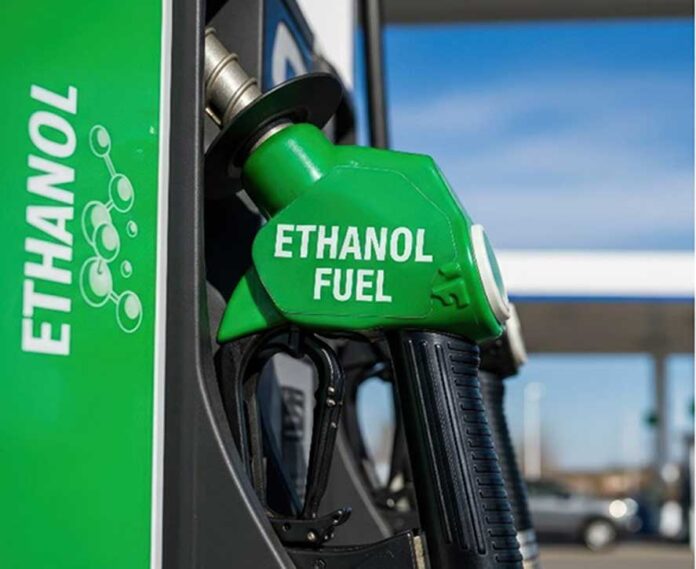
As India balances energy security goals, decarbonisation targets, and rising transportation demand, the country’s biofuel sector is preparing for its next phase of growth beyond the achievement of 20 per cent ethanol blending. Against this backdrop, KPMG in India has released a new report titled “Ethanol: Beyond E20 – Repositioning Ethanol as India’s Transport Energy Backbone”, which outlines a strategic roadmap for developing a more diversified, sustainable, and resilient ethanol ecosystem.
The report explores the evolving dynamics of India’s ethanol sector as it moves beyond the E20 milestone. It highlights critical opportunities and challenges across key areas including feedstock availability, supply chain efficiency, infrastructure development, and policy coordination. According to the report, sustaining growth in the sector will require a transition from a focus on capacity expansion and scale creation to one centred on system-wide optimisation, efficiency, and long-term resilience.
With ethanol expected to play an increasingly important role in India’s energy transition, the report underscores the need for an integrated approach that strengthens the entire value chain while supporting the nation’s broader mobility, environmental, and energy security objectives.
Looking ahead, the report underscores the need for greater emphasis on second-generation (2G) ethanol, expanded adoption of alternative feedstocks such as maize and agricultural residues, and improvements in production efficiency. It highlights the importance of addressing challenges related to feedstock availability, food-fuel balance, pricing mechanisms and supply chain logistics to ensure a stable and reliable ethanol supply.
The report also emphasises the role of coordinated ecosystem development, including scaling flex-fuel vehicle adoption, strengthening blending and distribution infrastructure, enhancing storage capacity and ensuring policy coherence. In addition, improved coordination, transparency and system-level visibility across the supply chain are expected to play a critical role in improving operational efficiency and transparency across the ethanol value chain.
From a sustainability perspective, the report examines ethanol’s role in supporting emissions reduction in the transport sector, while drawing attention to lifecycle emissions, water use efficiency and resource intensity considerations. It highlights the importance of embedding sustainability across the value chain to align production growth with broader environmental objectives.
Anish De, Global Head of Energy, Natural Resources and Chemicals (ENRC), KPMG International said “As energy systems undergo structural transformation globally, India’s ethanol programme stands as a compelling demonstration of how aligned policy frameworks, industry coordination and scale can decisively shift the needle on import dependence while sustaining economic momentum. Having achieved the E20 milestone ahead of schedule, the imperative now is to move from scale creation to system intelligence — where ethanol transitions from a blending mandate to a foundational pillar of a resilient, flexible and future-ready transport fuel ecosystem.”
Vivek Rahi, Partner and National Head, Oil and Gas, KPMG in India said “India’s ethanol journey has evolved from a targeted blending directive to a structurally significant component of the nation’s transport energy architecture. As the sector advances beyond E20, the strategic priority must shift toward feedstock diversification, demand-side flexibility and infrastructure alignment at scale. This inflection point presents a defining opportunity — to reposition ethanol not merely as a compliance instrument, but as a sovereign energy lever capable of reinforcing long-term energy security and accelerating India’s low-carbon transition.”
Key insights from the report include the below :
- India’s ethanol blending programme has achieved significant scale, with E20 operationalised nationwide; sustaining growth will depend on feedstock diversification and system-level supply alignment
- Second-generation ethanol and non-food feedstocks are expected to play a critical role in enabling incremental supply and reducing dependence on 1G pathways
- Expansion and evolution of storage, transportation and distribution infrastructure toward multi-grade systems will be essential to support higher blends and ensure reliable supply
- Policy alignment and evolution of pricing mechanisms toward a more market-responsive framework will remain central to long-term sector viability and investor confidence
- Improved coordination, transparency and system-level visibility across production and supply chains are expected to enhance operational efficiency
- Sustainability considerations, including emissions reduction, water use efficiency and resource intensity, are becoming integral to future ethanol strategies
Together, these insights reflect a sector transitioning into its next phase, where the focus shifts from achieving scale to enabling system-level alignment, resilience and sustainability. Progress will depend on feedstock diversification, evolution of pricing and policy frameworks, and coordinated development of supply, infrastructure and demand ecosystems.