Toyota Kirloskar Motor (TKM) has reaffirmed its commitment to biodiversity conservation on the occasion of the International Day for Biological Diversity 2026. In line with the Toyota Environmental Challenge 2050 (TEC 2050), the company continues to advance initiatives focused on protecting and enhancing biodiversity across its operations and surrounding communities.
Driven by its philosophy of “Respect for the Planet” and the principles of The Toyota Way, TKM is actively integrating biodiversity conservation into its manufacturing processes, community outreach activities, and broader environmental sustainability programs.
Driving Biodiversity through Measurable Impact:
TKM has undertaken several initiatives to enhance green cover, conserve natural resources and support ecological balance around its manufacturing facilities. Through large-scale tree plantation drives, water conservation measures, lake rejuvenation activities and habitat restoration programs, the company contributes towards preserving local biodiversity and strengthening environmental resilience.
As part of its TEC 2050 challenge, TKM envisions transforming the Bidadi plant into a thriving green sanctuary through initiatives such as:
The Toyota Greenwave Project: This is our ambitious flagship initiative devoted to cultivating ecologically resilient habitats through Miyawaki afforestation and strategic green-belt development. It is a collaborative movement that unites the entire TKM community under a mutual vision of transforming the Bidadi plant into a thriving green sanctuary.
Today for Tomorrow: This programreflects our symbiotic relationship with environmental stewardship through large-scale conservation and biodiversity enhancement. We recognize that thriving ecosystems are foundational to supporting all forms of life and our initiatives are designed to strengthen this interdependence.
Education for Sustainable Development (ESD): We believe that meaningful and lasting environmental change begins with education. Through this program, we strive to inspire students to embrace a mindset of ecological responsibility and inculcate eco-conscious behavior.
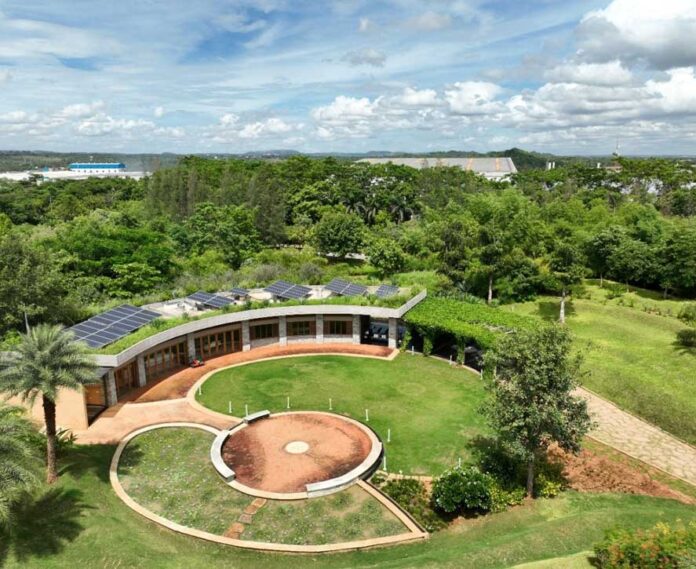
Building awareness and Future Stewardship: The company’s 25-acre Ecozone, an experiential ecological learning hub that supports both conservation and awareness, hosts over 650 native plant species (including 25 IUCN red listed species) and has documented around 400 faunal species (including 4 IUCN red listed species) since its establishment. To date, the Ecozone has engaged and inspired over 62,000 students and stakeholders on sustainable living practices.
Creating Green Ecosystems beyond the Boundary: Further reinforcing its commitment to sustainability, TKM has advanced large‑scale afforestation and ecosystem restoration programs both within and beyond its campus. During the reporting period, the company planted 747 saplings internally and 1,492 saplings externally. At the Channapatna Police Training School, TKM developed over 6.6 acres of land using the forest tree planting method, introducing approximately 4,090 saplings across 33 native species. This initiative is designed to prevent soil erosion, enhance biodiversity, improve air quality, and support groundwater recharge, while fostering community participation and long‑term environmental stewardship.
Expanding its community‑focused biodiversity initiatives, TKM has partnered with the Government of Karnataka to develop an Environment Theme Park and Experiential Learning Centre at Nadaprabhu Kempegowda Vanadhama, Savandurga. Developed in collaboration with the Karnataka Forest Department, the project enhances the park’s ecological, socio‑economic, and educational value. The initiative emphasizes ecological restoration, water management, biodiversity conservation, and the revitalization of heritage structures — creating a holistic model of community‑driven environmental responsibility.
Water, Energy and Waste: Advancing Resources Efficiency: Water stewardship remains a critical pillar of TKM’s environmental strategy. Nearly 89% of TKM’s water requirements are met through rainwater harvesting and recycled water. During the reporting period, the company utilized 1.73 million m³ of water, supporting its Zero Liquid Discharge goals. Additionally, TKM has achieved 100% renewable grid electricity across its manufacturing operations through which 509000 tCO2e emissions were avoided from manufacturing in the reporting year. It also maintains over 96% waste recycling, following a Zero Waste to Landfill approach.
Beyond operational initiatives, TKM actively promotes responsible resource management through waste reduction, recycling, energy efficiency, and environmental awareness programs among employees and stakeholders.
Mr. B. Padmanabha, Executive Vice President and Director, Manufacturing, Toyota Kirloskar Motor Pvt. Ltd., said, “Sustainability is deeply rooted in The Toyota Way and guided by our philosophy of ‘Mass Happiness for All.’ It shapes how we think, act, and create value across our ecosystem. Our journey towards a greener future is a shared commitment to the communities we serve and to future generations. Biodiversity conservation remains a critical pillar of this approach. Through our initiatives, we are building ecosystems while promoting greater environmental responsibility.”
TKM remains committed to scaling its biodiversity and conservation initiatives through:
- Expanded afforestation programs
- Advanced water stewardship practices
- Stronger community and government partnerships
- Increased environmental education outreach
As India accelerates its journey towards a sustainable future, TKM continues to create a meaningful and lasting positive environmental impact—building ecosystems that benefit both people and the planet.