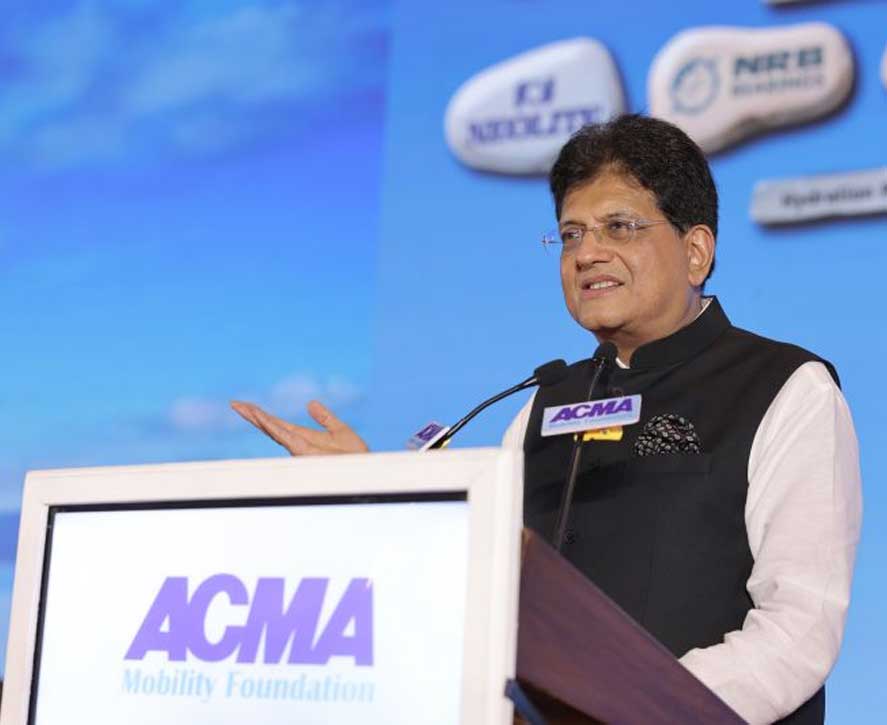
Commerce and Industry Minister Piyush Goyal has urged Indian auto component manufacturers to move beyond exports and establish manufacturing operations in developed markets, calling global expansion the next phase of growth for the industry.
Speaking at the 66th Annual Session of the Automotive Component Manufacturers Association of India (ACMA), Goyal said Indian suppliers have developed strong capabilities in cost competitiveness and quality and are now ready to compete more aggressively in international markets.
“Now it is time that we go to the world. We start manufacturing across the world. We start making our footprint in developed countries,” Goyal said.
Goyal encouraged auto component manufacturers to leverage the market access created through India’s recent trade agreements to expand their presence in Europe, the US and other developed economies. According to the minister, nine trade agreements finalised by the government in recent years provide access to 38 developed countries with a combined GDP of around $60 trillion.
He said the auto component industry’s position during trade negotiations has consistently been that Indian manufacturers are ready to compete with global players as long as they receive reciprocal market access.
“Get us zero-duty access in that country and open up our sector to zero-duty from that country. We can take on the best in the world, happy to take on any challenge,” Goyal said, recalling the industry’s stance during trade negotiations.
The minister also called on Indian suppliers to move up the value chain by developing higher-value integrated products and solutions instead of focusing solely on manufacturing individual components.
“Move up the value chain,” he said. “I think it’s time we started delivering integrated very high-value solutions where we have designed, built and supplied to the world top-quality products which should be the envy of the world.”
The push comes as the automotive component industry increasingly takes on greater responsibility for product design, engineering, technology development and systems integration, rather than simply manufacturing parts according to specifications provided by vehicle manufacturers.
At the same time, Goyal stressed that global expansion should be accompanied by stronger and more resilient domestic supply chains. He urged manufacturers to identify areas where excessive import dependence could expose their businesses to disruptions and encouraged them to pursue active indigenisation programmes.
“For those products where you still need to bring resilience in your supply chain, have an active indigenization program to insulate and protect yourself from future black swan events,” he said.
Goyal said government initiatives supporting speciality steel, technical textiles and semiconductors should also be viewed as efforts to strengthen India’s automotive supply chain. He highlighted critical minerals as another strategic area, noting that the government is working to diversify sourcing and explore trade arrangements with additional countries to improve access to these essential resources.
The minister particularly encouraged Indian component manufacturers to look beyond traditional export markets and target developed economies such as the US and Europe. He said stronger international partnerships could help create jobs and drive economic growth both in India and overseas.
“Gone are the days where one had to look from a position of fear or a defensive position,” Goyal said. “Both parties can play offensive.”
He added that India and its international partners could work together to improve competitiveness and capture a larger share of global markets.
Goyal also raised the possibility of creating dedicated industrial infrastructure for auto component manufacturers in India. Referring to plans for additional industrial smart cities equipped with plug-and-play infrastructure, he suggested that some of these facilities could potentially be developed specifically for the automotive component industry.
“Maybe we can add two or three, five parks which will be for auto components only. Then I can create a plug and play infrastructure to suit you directly,” he said.
However, Goyal presented the proposal as a possibility rather than a formal government announcement.
With Indian automotive suppliers increasingly strengthening their capabilities in technology, engineering and manufacturing, the minister’s message was clear: the industry’s next phase of growth will require a combination of deeper indigenisation at home and greater manufacturing and technology presence in global markets.